
Gopika – Year 12 Student
Editor’s Note: Year 12 student Gopika entered recently entered this essay in the Peterhouse Kelvin Biological Sciences Essay Competition, a prestigious essay competition run by Peterhouse College, Cambridge. This is an informative, thoroughly researched and clearly presented essay that address the broad spectrum of mitochondrial shapes and sizes. CPD
The etymology of the word ‘mitochondria’ is from ‘mitos’ (thread) and ‘chondros’ (granule), indicating its varied morphological features. Mitochondria are almost always depicted as ovals for simplicity. In fact, they have a diverse range of shapes and sizes and can undergo fission and fusion forming dynamically shaped networks which are crucial for cell physiology.
Conventional depiction.
The conventional depiction of mitochondrial structure comes largely from electron microscopic (EM) studies. Often, they are depicted as ovoid, roughly spherical or small rods. One reason may be fragmentation of mitochondrial networks as can happen in oxidative stress or in dying cells. Networks may break down, so mitochondria assume their typical ‘bean’ like appearance.
An alternative explanation for the solitary ovoid appearance is that the same mitochondrion could have been sectioned through small slivers of a mitochondrial network.
A third explanation for the ovoid shape could be that it is a fractionation artefact from fragmented vesicles of the original mitochondrial network.
The disadvantage of viewing these cells using electron microscopes is that we can only see the mitochondria at a fixed point in time as electron microscopes cannot be used on live specimens. This poses challenges when observing how mitochondria change shape. Future studies of mitochondrial structures will be aided by developing microscopy techniques such as: live cell imaging, serial block-face scanning electron microscopy; correlative light EM; transmission EM; focused ion beam-SEM and mass spectrometry imaging.
Serial block face scanning electron microscopy has shown that mitochondria are dynamic organelles with a variety of shapes and networks in different tissues and different types of cells. For example, in cardiac tissue, it is a single compact structure whereas in skeletal muscle, they form highly connected networks. The varied shapes can all exist within a single tissue; however, certain tissue types are more likely to have characteristically shaped mitochondria. For instance, mitochondria in the liver change between spherical and doughnut forms but cardiac muscle cells have elongated mitochondria arranged in parallel.
Morphology may even vary within an individual cell and this variation can indicate differences in function. Intra-tissue and inter-tissue mitochondrial populations will also change in response to inhibitors, oxidative stress and substrates which reveal their plasticity and complexity. Mitochondria are said to have pluralistic roles as mitochondrial dynamics are crucial for regulating many processes such as apoptosis, not just ATP production. There are several processes that regulate mitochondrial structure such as fusion, fission, extension, retraction, and mitochondrial biogenesis. Mitochondrial shape also varies with pathology.
Mitochondrial phenotypes
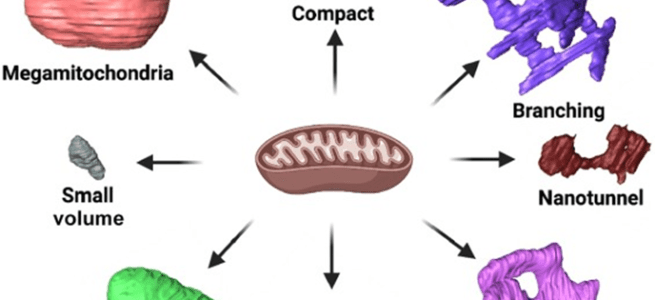
There are eight mitochondrial phenotypes observed so far.

Small Volume
This shape is often found in regions of high respiratory rate so they can deliver energy rapidly. It is also commonly observed throughout the aging process and reduced volume of these mitochondria can be representative of Parkinson’s and Alzheimer’s disease.
Large volume
The larger volume results in increased rate of energy generation even with fewer mitochondria. Unnatural enlargement of large volume mitochondria may be linked to heart failure.
Compact
These mitochondria show enhanced oxidative phosphorylation and rearrangement of the cristae. They can be associated with conditions linked to oxidative stress such as ischemia.
Elongated
Elongated mitochondria have a very high surface area: volume ratio which could be beneficial for increased interactions. Extreme elongation is characteristic of some neurodegenerative diseases.
Branching
These are intricate mitochondrial networks that allow contents of the matrix to mix but altered branching may be observed in cancerous cells.
Megamitochondria
When mitochondria swell to two or three times their original size without considerable damage to their outer membrane, they are classified as Mega mitochondria (MG’s). These phenotypes are quite large and can even reach the size of the nucleus. MGs develop because of diseases, for example nonalcoholic liver disease; however, the effect of these morphologies on cell function is largely unknown. In addition, the mechanism of MGs formation is not entirely clear, however it is likely that fusion and fission defects are responsible. This is because during stress, fusion enables genetic complementation and maximises oxidative capacity as a compensatory mechanism. When MGs form from multiple fusion events, they may have more than one nucleoid, containing mitochondrial DNA (mtDNA), which may impact their function. As MGs are so large, they could also form from stress-induced hyperfusion or the buildup of dysfunctional mitochondria due to fission defects.
Nanotunnel
While investigating Alzheimer’s diseases, 3D EM showed a new mitochondrial phenotype named ‘mitochondria – on – a-string’ and later these were called nanotunnels. They have a thin tunnel connecting the mitochondria which can transport crucial proteins between them. Incomplete fission could be a cause for this peculiar shape but there may also be a correlation between nanotunnel formation and mitochondrial DNA (mtDNA) mutations. This is because cell damage from mtDNA mutations can cause excessive fission, thus increasing the changes of tunnel formation.
Mitochondrial doughnut
Reactive oxygen species (ROS) production can result in a reversible transition from tubular to doughnut shaped mitochondria. Therefore, these mitochondria have increased ROS levels. They can also appear more frequently in regions such as the liver due to metabolic stress. Interestingly, the memory impairment of Alzheimer’s disease simultaneously leads to an increase in doughnut shaped mitochondria.
Scientific understanding of doughnut-shaped mitochondria has advanced with developments in EM and live cell imaging. These shapes form when opposite ends of a mitochondria undergo fusion, although, the details of this mechanism are yet to be discovered. They have been seen under hypoxic conditions and have been linked to changes in osmotic pressure. However, when these mitochondria return to normal conditions, they can quickly change into other morphologies. Therefore, this suggests the doughnut shape could be an adaptive response to increase mitochondrial surface area. As the study of mitochondrial doughnuts continues, it is imperative that more advanced techniques are utilized because some EM techniques mistakenly identify discoid shapes mitochondria as doughnuts.
Factors affecting mitochondrial morphology
Fission and Fusion
These are the two principal mechanisms determining mitochondrial morphology. During fusion, mitochondria become branched tubular networks allowing the contents of the matrix, such as enzymes to mix. The dumbbell-shaped or racket-shaped appearance of mitochondria in electron photomicrographs may be due to fission. This dumb-bell shape is seen just before separation. The handles of racket-shape of mitochondria are likely to be bridges connecting separating mitochondrial halves.
The interaction of fusion and fission create diverse mitochondrial morphologies such as: rods, sausage shapes, looped structures, and branched networks. Networks are advantageous as they increase respiratory activity. In neurons and sperm cells with high metabolic rates, networks are crucial for efficient aerobic respiration. A fascinating exemption to this relationship is HeLa cells, which have decreased mitochondrial respiration as network length increases.
Mitochondrial movement
Mitochondrial movement can also affect morphology. One type of movement is extension, where the organelle increases in length and another is retraction where the organelle decreases in length. Interestingly, both mechanisms are completely distinct to fusion and fission. For instance, observations show that extension and retraction can only occur in rod shaped organelles and not spherical mitochondria. These movement processes enable mitochondria with a higher surface area to travel at faster speeds. At 37 degrees Celsius, mitochondria can even travel at 1000 nm per second! This is advantageous to organisms as mitochondria can rapidly accumulate in regions requiring high metabolic activity.
Sex –dependent modulators
With aging, the level of oestrogen falls and this can impact mitochondrial morphology. In monkeys who have had ovaries removed, doughnut-shaped mitochondria are found, which may indicate Alzheimer’s disease. In such cases, treatment with oestrogen can restore normal mitochondrial morphology.
Nucleoids
Damage to mitochondria can result in nucleoid condensates associated with peripheral fission of mitochondria.
MICOS complex
The MICOS (mitochondrial contact site and cristae organising system) is involved in aging and may affect overall mitochondrial shape.
Other potential modulators
As more evidence emerges, new mitochondrial shaping proteins are being discovered unveiling the secrets behind the complex mechanisms that determine mitochondrial morphology.
Mitochondria are simply much more than the ovoid solitary ‘powerhouse of the cell.’ The changes in mitochondrial morphology occur due to it interchanging between period of being static and constantly moving or fusion and fission in a dynamically changing network.
In conclusion, it is the distinct and varied needs of individual cells which have led to such a diverse range of specific adaptations over time that are responsible for mitochondrial morphological mayhem.
Bibliography
Campello, S. and Scorrano, L. (2010). Mitochondrial shape changes: orchestrating cell pathophysiology. [online] Available at: https://www.ncbi.nlm.nih.gov/pmc/articles/PMC2933866/ [Accessed 7 Apr. 2024].
Cantó, C. (2018). Chapter Four – Mitochondrial Dynamics: Shaping Metabolic Adaptation. [online] 340, pp.129–167. Available at: https://www.sciencedirect.com/science/article/abs/pii/S1937644818300546 [Accessed 7 Apr. 2024].
Chen, Q., Liu, L.-Y., Tian, Z., Fang, Z., Wang, K.-N., Shao, X., Zhang, C., Zhou, W., Rowan, F., Qiu, K., Ji, B., Guan, J.-L., Li, D., Mao, Z. and Diao, J. (26AD). Mitochondrial nucleoid condensates drive peripheral fission through high membrane curvature. [online] 42(12). Available at: https://www.sciencedirect.com/science/article/pii/S2211124723014845 [Accessed Apr. 7 2024].
Glancy, B., Kim, Y., Katti, P. and Willingham, B. (2020). The Functional Impact of Mitochondrial Structure Across Subcellular Scales. [online] 11. Available at: https://pubmed.ncbi.nlm.nih.gov/33262702/ [Accessed 13 Apr. 2024].
Hales, K.G. (2010). Mitochondria, Fusion, Division | Learn Science at Scitable. [online] http://www.nature.com. Available at: https://www.nature.com/scitable/topicpage/mitochondrial-fusion-and-division-14264007/. [Accessed 13 Apr. 2024].
Hara, Y., Yuk, F., Puri, R., Janssen, W.G.M., Rapp, P.R. and Morrison, J.H. (2013). Presynaptic mitochondrial morphology in monkey prefrontal cortex correlates with working memory and is improved with estrogen treatment. Proceedings of the National Academy of Sciences, [online] 111(1), pp.486–491. doi:https://doi.org/10.1073/pnas.1311310110. Available at Presynaptic mitochondrial morphology in monkey prefrontal cortex correlates with working memory and is improved with estrogen treatment | PNAS [Accessed 21 Apr. 2024].
Jenkins, B.C. and Neikirk, K. (2024). Mitochondria in disease: changes in shapes and dynamics. [online] 49(4), pp.346–360. Available at: https://www.cell.com/trends/biochemical-sciences/fulltext/S0968-0004(24)00031-8?_returnURL=https%3A%2F%2Flinkinghub.elsevier.com%2Fretrieve%2Fpii%2FS0968000424000318%3Fshowall%3Dtrue#%20 [Accessed Apr. 7 2024].
Kwon, D. (2019). Biologists Discover Unknown Powers in Mighty Mitochondria. [online] Quanta Magazine. Available at: https://www.quantamagazine.org/shape-shifting-mitochondria-direct-stem-cells-fate-20190318/ [Accessed 14 Apr. 2024]
Liu, X. and Hajnoczky, G. (2011). Altered fusion dynamics underlie unique morphological changes in mitochondria during hypoxia-reoxygenation stress. [online] 18(10), pp.1561–1572. Available at: https://pubmed.ncbi.nlm.nih.gov/21372848/ [Accessed Apr. 7 2024].
McCarron, J.G., Wilson, C., Sandison, M.E., Olson, M.L., Girkin, J.M., Saunter, C. and Chalmers, S. (2013). From Structure to Function: Mitochondrial Morphology, Motion and Shaping in Vascular Smooth Muscle. [online] Available at: https://www.ncbi.nlm.nih.gov/pmc/articles/PMC3884171/ [Accessed 14 Apr. 2024].
Newman, T. (2018). Mitochondria: Form, function, and disease. [online] http://www.medicalnewstoday.com. Available at: https://www.medicalnewstoday.com/articles/320875. [Accessed 20 Apr. 2024]
Trushina, E. (2016). A shape shifting organelle: unusual mitochondrial phenotype determined with three-dimensional electron microscopy reconstruction. Neural Regeneration Research, 11(6), p.0. doi:https://doi.org/10.4103/1673-5374.184477. Available at : A shape shifting organelle: unusual mitochondrial phenotype… : Neural Regeneration Research (lww.com) [Accessed 6 Apr. 2024].
Vincent, A.E., Turnbull, D.M., Eisner, V., Hajnockzy, G. and Picard, M. (2017). Mitochondrial Nanotunnels. [online] 27(11), pp.787–799. Available at: https://pubmed.ncbi.nlm.nih.gov/28935166/ [Accessed 21 Apr. 2024].
Wellcome Trust Centre For Mitochondrial Research. (n.d.). Home. [online] Available at: https://www.newcastle-mitochondria.com/patient-and-public-home-page/what-do-mitochondria-look-like/. [Accessed 10 Apr. 2024]
Wollweber, F., von der Malsburg, K. and van der Laan, M. (2017). Mitochondrial contact site and cristae organizing system: A central player in membrane shaping and crosstalk. [online] 1864(9), pp.1481–1489. Available at: https://tinyurl.com/272hevxx [Accessed 6 Apr. 2024].

 The GSAL Journal