
Amelie (Year 9 Student)
Editor’s note: Year 9 student Amelie has written this excellent review of a recent year group visit to the theatre to watch a stage production of Animal Farm. CPD
Manipulation, deception and inequality. These are all words that could be tied to Tatty Hennessy’s much anticipated stage adaption of George Orwell’s “Animal Farm”, which was produced to mark the 80th anniversary of the original novel.
On Wednesday, 12th March, a group of Year 9 students were lucky to visit Leeds Playhouse to watch this compelling play version, directed by the esteemed Amy Leach and featuring well-regarded actors such as Tachia Newall and Robin Morrissey, who play the central protagonists, Napoleon and Snowball.
Orwell’s dystopian novel, written in 1945, is an allegory for the Russian ruler, Stalin, and his reign of power. However, this play version takes a broader approach to the original ideas of “Animal Farm”. It forces the audience to question what makes us who we are and what it is to be human. Through the tale of an animal revolution, we see the inequality in life through a new perspective. The director focuses on the reality that no one chooses what situation they are born into, and these situations determine if a person has the opportunity to flourish and thrive in life, or crash and burn. The play deals with difficult topics such as violence and death, but it shows us all who we truly are in life.
While much of the play is fast-paced, with plot twists and turns which leave you on the edge of your seat in anticipation of what will happen next to the characters, the opening scenes use slow motion techniques and pared back dialogue to captivate the audience.
For me, the standout actor was Tom Simper, in the role of Squealer. In this adaptation, Squealer plays a more manipulative role, sometimes overshadowing Napoleon, unlike the original tale. Always able to justify the actions of Napoleon, he is the spokesperson for the “man” in charge. He is the force behind the illusion that the rest of the animals are under – that everything that is happening to them is for their benefit. Simper’s amazingly convincing delivery of propaganda leaves even the audience, who should know better, questioning that perhaps what he is saying is for the good of everyone.
It was heartening to see that the performance is adapted to incorporate layers of access. For example, once actor Everal A Walsh, who plays Old Major, has delivered his lines and completed his stage duties, he disappears backstage to narrate a live audio description of the rest of the performance whilst remaining in character. This gives people who are visually impaired a way to enjoy the creative experience through their headsets.
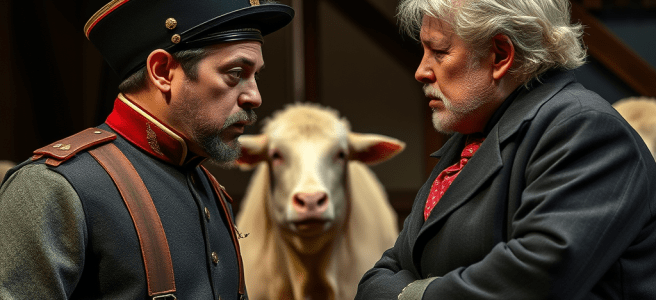
One of my favourite aspects of this play is the choice of costume and set design. Each animal is designed so they look like us. The actors do not wear masks or anything else to make them look like animals; minimalistic costume designs are used to differentiate one animal from another. The set takes the concept of “Big Brother is always watching you” (from Orwell’s novel “1984”) to a whole new level. The aesthetic is stark and industrial, with a huge metal cage, occupied by the pigs, towering over the stage. Floor to ceiling windows reinforce the themes of control and inescapable oppression, and the pigs’ movement from the stage to the cage strengthens the feeling hierarchy. The use of lighting, particularly red lighting with its connotations of violence, intensifies the oppressive mood of the production.
Overall, I believe that this was a spectacular performance and a fitting way to mark the novel’s 80th anniversary. It was an opportunity not to be missed!

 The GSAL Journal