
Naomi (Year 9 Student)
Editor’s note: This excellent essay was submitted to the annual Perse Aristotelian Award Essay Competition. CPD
“It has been said that arguing against globalisation is like arguing against the laws of gravity” Kofi Anann
Introduction
What type of challenge are we confronting? The combined wealth of the eight richest individuals is equivalent to the poorest half of the global population, 3.6 billion people (Hope, 2017). This is a vivid illustration of global inequality because of globalisation.
Globalisation refers to the process in which countries and various economic and cultural groups connect through the transportation of goods as well as advancements in social and technological developments (Drew, 2024). This can also include political and economic adjustments. Some view it as beneficial for humanity, while others view it as a cause for a development gap, which some people portray as disastrous.
History
In order to fully gain a picture of what globalisation is, we can observe its history. Globalisation had begun since trade first formed; however, this was commonly between people in the same area or region. What we would assume globalisation is, is where it is on a global scale, hence the name. This can be seen in the Silk Roads (1st century BC-15th century AD), where this luxury good (silk) was transported on a wider scale (through China to Rome) than what was thought to be ordinary. This was not a serious form of globalisation, and the value of these trades did not affect the overall economy. However, as we go throughout history, we can conclude that globalisation had increased its power through time as we see the Spice routes (7th–15th century) alongside the Silk Roads. The Age of Discovery (15th-18th centuries) was known to have become a more global era of trade; however, many still believed that the economy had not, yet, fully been globalised.
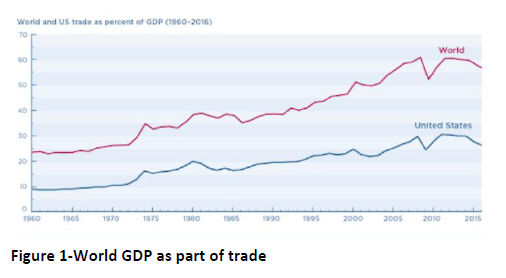
This changed when we reached the First Industrial Revolution. During this time the First Industrial Revolution was known to be in the First wave of globalisation (19th century-1914), where the British Empire had been dominating the globe and attacking the international market with industrial technologies (Atterbury, 2011). The starting point of the two world wars (1914) resulted in noticeable progress in mechanisms. Nevertheless, it aided the downfall of globalisation. By the end of World War 2 (WW2), global trade severely dropped to 5% of the world’s GDP from 14% just prior to the beginning of WW1. This significant reduction had not been formally observed for over a century. After WW2 came the second and third waves of globalisation, where we met the internet and the telephone. By this time, half of the world’s economy came solely from trade (see figure 1).We are currently in Globalisation 4.0, where we have encountered the uses of Artificial Intelligence as well as challenges such as global warming (Vanham, 2019).
From this history, we can conclude that globalisation originated from the start of human existence, but as time progressed, the scale increased while trade became more common and new knowledge had been acquired. This is what globalisation has become, and it is a debatable topic as it can be viewed as necessary or an issue.
Globalisation is widening the gap
There are many advantages to globalisation; however, concerns with its growth including its role in widening the gap between wealthy and developing countries.
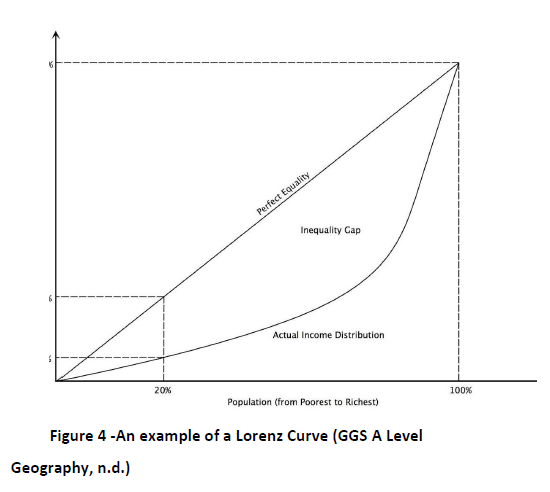
One way to put this into perspective is using The Gini Coefficient. It assigns a score between zero and one or as a percentage from 0 to 100. A score of zero indicates perfect equality, while an increasing score signifies a greater disparity between those who earn more and those who earn less. A score of one suggests perfect inequality (GGS A Level Geography, n.d.). This coefficient is applicable at a country level (Hasell et al., 2023; see figure 2), and it can be observed from a national perspective. The Global Gini Coefficient has significantly increased from 0.5 in 1820 to 0.657 in 1980 and 1992 (Hayes, 2024, see figure 3). A more recent figure estimates the score to be at 0.67 from the World Inequality Lab, 2020. In order to show the exact distribution of income across the population, the Gini Coefficient can be plotted onto a Lorenz Curve instead of using percentages (The Investopedia Team, 2024, see figure 4).
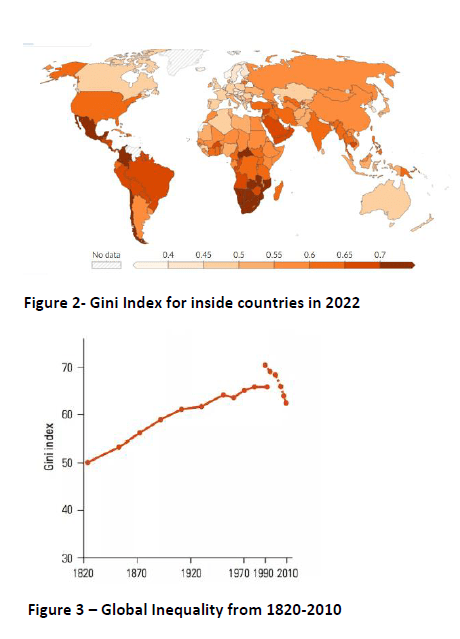
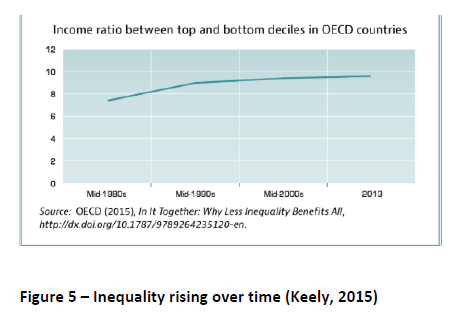
This information indicates global inequality has increased, which therefore means that it is probable that countries with more wealth increase their average income and trade whilst those in developing countries become increasingly poverty-stricken. The wealthiest 10% of the population earns 9.6 times more than the poorest 10%, implying a large gap between those who are more fortunate than those who are receiving substantially low incomes (Keeley, 2015, see figure 5). A main contributor for this inequality is the advanced economies using developing nations for manufacturing jobs. Many believe that this has caused Low Income Countries (LICs) to be exploited towards poor working conditions (Klawans,
2024) and has caused millions of workers to receive a low income. These businesses directly pick out these countries to minimise costs, assuming that a lower wage is satisfactory and a more cost-effective decision. These companies are benefited from globalised effort, more accurately described as global poverty chains (Selwyn, 2022), but the labourers receive the downside.
Therefore, those in High Income Countries (HICs) receive more as they are earning the products made in developing countries for more than they pay the workers. These workers are underpaid, and are unable to find any other job, causing a decline in wealth for that country.
Globalisation is narrowing the divide
Globalisation has caused some concern over how it has resulted in inequality; however, there are ways in which it has assisted in closing the gap using some main factors. New research has opposed the belief of a widening gap and instead
brought a new idea that during the increased globalisation period, inequality globally has mostly diminished (International Chamber of Commerce, 2003).
It has been mostly concerning those in developing countries earning more rather than financially stable countries decreasing in power and wealth. This is evident in how people living in these countries earning less than $1 on a daily basis decreased from 79 to 27 percent in China—52%, 63 to 42 percent in India—21% and 55 to 11 percent in Indonesia—44% (Bardhan, 2006). These are all rapid decreases in a short period between 1981 and 2001 and demonstrate the sharp decline in poverty and the encouragement of replication in wider parts of the globe. Overall, the decline since 1981 has reached 375 million people globally (Dollar, 2024) highlighting poverty has decreased in poor countries.
There have been economists and others suggesting developing countries may not be on the downside of globalisation. One theory proving this is the liberal economic theory (Guest, 2024) that explains how an economy can grow when using resources available in a place. They argue that those in developing countries will eventually catch up with wealthier countries as technology advances and incomes rise. Developing countries can also benefit from companies investing there, as it will modernise the country and accelerate growth industrially.
Conclusion
Globalisation is an essential piece in a nation where technology advances sharply and trade is occurring more frequently than ever before. It is impossible to ignore it, as it can influence our daily lives, like cultural globalisation, where we learn new things about the larger society we live in today. While it is undeniable inequality exists in the world and people see a gap between these countries, there is evidence of incomes rising, improved life expectancy, and resources around the
world increasing in availability. However, with the research provided we can conclude that globalisation is widening the gap between rich and poor countries, even with the opportunities of improvement.
Bibliography
3.7 Globalisation and development. (n.d.). Retrieved December 28, 2024, from GGS A Level Geography website: https://sites.google.com/gravesendgrammar.eu/ggsalevelgeography/topic-3-globalisation/3-7-globalisation-and-development
Atterbury, P. (2011, February 17). Victorian Technology. Retrieved January 1, 2025, from BBC website: https://www.bbc.co.uk/history/british/victorians/victorian_technology_01.shtml
Bardhan, P. (2006, March 26). Does Globalization Help or Hurt the World’s Poor?: Overview/Globalization and Poverty. Retrieved January 3, 2024, from Scientific American website: https://www.scientificamerican.com/article/does-globalization-help-o-2006-04/ Copilot. (2023). Microsoft [Large Language Model]. Retrieved December 27, 2024, from Copilot website: https://copilot.microsoft.com/chats/VivT6C9STcKp47YTXmw9H (Asked question “Can I have some quotes on globalisation”, received quotes, asked another question “Can I have some more quotes on globalisation?”, and chose QUOTE for TITLE PAGE)
Dollar, David R. (2024). Globalization, poverty, and inequality since 1980. Retrieved January 1, 2025, from World Bank website: https://documents.worldbank.org/en/publication/documents-reports/documentdetail/107171468779167747/globalization-poverty-and-inequality-since-1980
Drew, C. (2024, February 2). 8 Types of Globalization (Definition & Explanation For Students). Retrieved December 29, 2024, from HelpfulProfessor.com website: https://helpfulprofessor.com/types-of-globalization/
Guest. (2024, December 26). GLOBALIZATION AND ECONOMIC INEQUALITY: A COMPLEX RELATIONSHIP – Legally Flawless. Retrieved January 3, 2025, from Legally Flawless website: https://legallyflawless.in/globalization-and-economic-inequality-a-complex-relationship/#theories_of_economic_inequality
Hasell, J., Arriagada, P., Ortiz-Ospina, E., & Roser, M. (2023). Economic Inequality. Retrieved January 1, 2025, from Our World in Data website: https://ourworldindata.org/economic-inequality
Hayes, A. (2024, April 14). Gini Index Explained and Gini Coefficients Around the World (S. Anderson & D. Rubin, Eds.). Retrieved January 1, 2025, from Investopedia website: https://www.investopedia.com/terms/g/gini-index.asp
Hope, K. (2017, January 16). Eight billionaires “as rich as world’s poorest half.” BBC News. Retrieved from https://www.bbc.co.uk/news/business-38613488
ICC. (2003, January 27). Globalization is narrowing the poverty gap. Retrieved January 1, 2025, from ICC – International Chamber of Commerce website: https://iccwbo.org/news-publications/news/globalization-is-narrowing-the-poverty-gap/
Selwyn, B. (2022, December 27). Global Capitalism Will Never Lift Workers Out of Poverty. Retrieved January 1, 2025, from Jacobin website: https://jacobin.com/2022/12/global-capitalism-poverty-global-value-chains-transnational-corporations-globalization
Keeley, B. (2015). Income Inequality: The Gap between Rich and Poor. OECD Publishing: OECD Insights. Retrieved from http://dx.doi.org/10.1787/9789264246010-en
Klawans, J. (2024). The pros and cons of globalization. Retrieved January 1, 2025, from msn
website: https://www.msn.com/en-gb/money/other/the-pros-and-cons-of-globalization/ar-AA1rFe4I?rc=1&ocid=winp1taskbar&cvid=5dbccd4bcd8f4fc688fdfed5a5c0fd15&ei=8
The Investopedia Team. (2024, December 15). Lorenz Curve (E. Rasure & S. Kvilhaug, Eds.). Retrieved December 31, 2024, from Investopedia website: https://www.investopedia.com/terms/l/lorenz-curve.asp
Vanham, P. (2019, January 17). A brief history of globalization. Retrieved December 31, 2024, from World Economic Forum website: https://www.weforum.org/stories/2019/01/how-globalization-4-0-fits-into-the-history-of-globalization/

 The GSAL Journal