

Guide to Writing an Article for the Humanities Journal
Miss Breen – Lawson Library
Do you want to write for the Humanities GSAL Journal, but have no idea where to begin? This guide will give you step by step tips on how to get involved. The goal of the Journal is to hear from as many voices from across the school as possible.

Your topic
This is arguably the hardest part because there are so many interesting, creative and inspiring ideas out there that one would like to write on. Humanities is such a large span of different genres and concepts that it may seem overwhelming. The most important thing to do though is to pick something that you are both passionate and interested in so that what you write about is informative and personalised.
Here are some ideas to get you started:

And this is just to name a few. Once you have your general idea start to make a mind-map of things that you want to discuss within it – as I am sure there will be a lot you want to mention. For example:

This mind map gives a few points as to what maybe going through your head. But with a word limit in a journal article/mini-essay it is important to only choose one and go into depth. Less is more. Also remember that there will be loads of mini-discussions and ideas within one point – especially if you have criticism included (criticism is when another academic or specialist has written an account, an article, an essay on the topic YOU want to talk about) – and having criticism included will make your article stand out, and be far more in-depth and thoughtful.
Research into your topic
This is the fun part! You can look at every single part of your topic, and find out which parts interest you the most! To do this, you need to make sure you are utilising all resources that are available to you and that the sources you use are both RELIABLE AND RECENT.
As a Librarian, I suggest using the Library as your first point of contact. Ask at the counter for help, or have a look on the catalogue.
Top tip: library catalogues are SUPER specific and not like Google search engine where it will bring up anything that you are searching, and if you want to find something specific you must go via title, author, word, or genre.
Below is an example of how to find Circe by Madeline Miller, I have selected ‘title’ and made sure to have the correct spelling in order to type in the name of the book. In order to find it look at the shelfmark: F:MIL – so, now I know it is senior fiction under M.
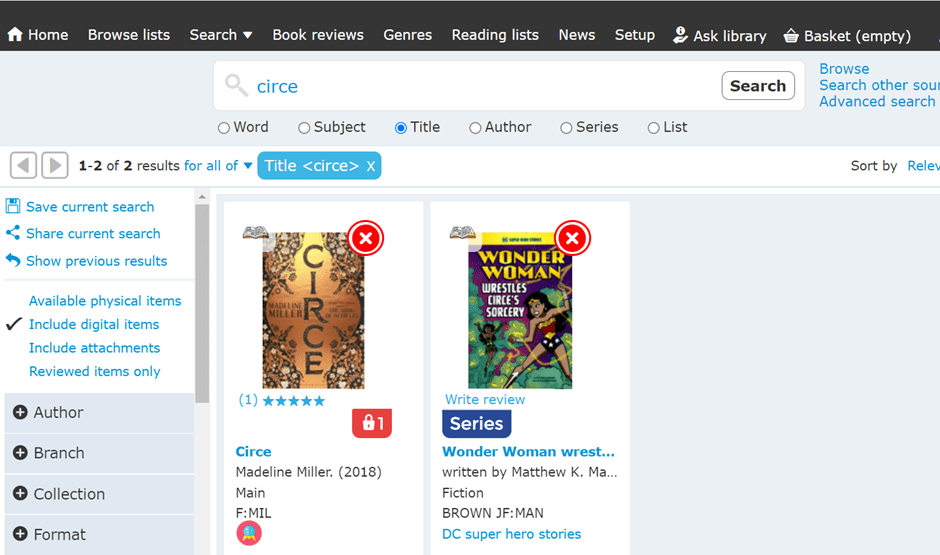
For CRITICISM, or academic writing that will back up what you want to say it’s best to select ‘word’, as shown here:

E.g. If you were wanting to get out Florence Given’s book to talk about contemporary feminism as a stark contrast to Mythological feminism, then you would go to 305.42 (which is next to the door of the den in the Library!)
It is best to make a research table:

This will make sure you keep track of every little piece of information you get, as this will help when you come to do future work or future articles for the journal. Have a table for websites and book names, the authors, and then what you got from them/quotes! Do not make it complicated as this is not academic work, but something along the lines of:
Oxford Blue Press. ‘How re-telling mythology is impacting feminism,’ by Grace Dowling, 2022.
It will be helpful as well to look at as many articles as possible to get inspiration on what language they use, how they write and how they get their arguments across!
Plan
Once you have your topic, and all your research and you know exactly what you want to write for the GSAL Journal. It is now time to PLAN it so that it is nice and concise for the reader.
Planning can be quite hard, but the best way to do it is think of how many words you have for your article. Say it is 1000 words, you want room for a nice introduction, two strong paragraphs and a rounding up paragraph/conclusion. You will have to be really specific with what you want to say!
I would suggest having two really strong points that contrast with each other, and this will allow you to have a balance in your argument as well as giving you the opportunity in the conclusion to vouch for your own opinion.
So that means:
100 words for an introduction
Remember to hook the reader with this section, and make sure to outline what you will be discussing in your article/mini-essay. This will make sure that the person reading stays with you throughout and also they can tell whether this article is for them.
400 words for the first paragraph
Your first point, and this should be backed up with at least two other sources so that it is not just a think-piece or a stream of consciousness, but something defined and researched. It will make your argument more thorough and developed.
400 words for the second paragraph
Your second point, again, this should be backed up with other research but don’t forget to write these sections with the same amount of flare and catchiness as the introduction! You want the reader to stay with you!
100 words for a conclusion
This is your chance to really remind the reader what this article is about, and what you want them to take away from it. Think to yourself what was the point of this and what do I want the other person to learn from this?
Once you have your two key points and your word count in your head – now it’s time to go through the research with a highlighter and see which bits relate the best to your points. Be strict!
Now you have your two points, your word count, your specific bits of research and you will have read lots and lots of articles to prepare yourself for the creation of your own article!
So step four is:
Write!
But remember: you don’t have to start at the beginning through to the end. Start anywhere that feels best! Some people find it easier to write their introduction last once they know EXACTLY what they have said throughout.
Once you are done with this, it is time for step 5. It is just as crucial as all the other steps:
Proof
After you have written it is very important to proof read your work. It is best to go away from the piece of work for 24 hours and then come back to it with fresh eyes. If you cannot do this, then ask a friend or relative or LIBRARIAN to read over it for you. Give it some tweaks before sending it into the journal. EB
 The GSAL Journal