
Felicity (Year 12)
Editor’s note: Year 12 student Felicity entered this essay into the Girton College, Cambridge, annual Humanities Writing Competition. Entrants were asked to research and write beyond the curriculum, using one or more of five selected objects from the Lawrence Room museum as their focus. Focusing on Girton’s museum collection in the Lawrence Room, the Humanities Writing Competition aims to use ancient objects as a starting point for thinking across curricular divides – about the varieties of human experience that these survivals from the past can embody and reflect and the trains of thought they can set off. CPD
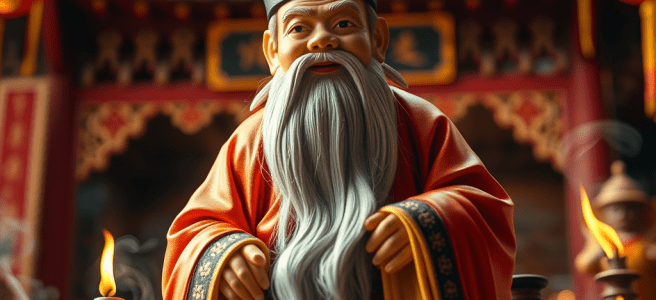
When setting your eyes upon the Tudigong, you are immediately hit with an immense sense of knowledge, riches and veneration. These words perfectly describe not only the look of the Tudigong, but also its role in worship in China and Taiwan. From the way he is dressed to the way people worship him, the figurine is a divine symbol of prosperity, wisdom and protection. The general consensus towards these statues provides the devotees with the comfort of safety, piety and community.
When researching the origins of the Tudigong, I came across many mythological and practical explanations for practicing and worshipping to the deity. ‘Tudi’ means land or earth and ‘gong’ means for the people. It directly translates to land for the people. This is an accurate name in accordance to what the figurine is used for in practise, he is completely dutiful to his people. The Tudigong is localised, with different areas of China and Taiwan worshipping to different Tudigong’ s, and if you migrate it is customary to begin worshipping the one that comes with your new home. This provides a sense of community, allowing all of the people in one area to worship to the same Tudigong, bringing not only themselves but their neighbours and friends protection. The gongs are on the lowest level of the hierarchy of the gods, but this Tudigong will have communications with the Jade Emperor (Yuhang Dadi (玉皇大帝)) the king of the Gods. This shows not only their divine standing, but also that they care about their people and are willing to help them. It shows how personal and intimate their relationship is with their people, as they are willing to fortify their land and act as a protector. It is believed they bring prosperity and good finance to those who pray to him, but he will also help them with their crop yield if they live in a rural area. They became popular during the Zhou Dynasty (1046-256 BC) and rituals of worship were solidified in the Han dynasty (206 BC- 220AD). He is still very prevalent today, being part of many festivals and daily worship for the Chinese and Taiwanese people despite China’s cultural revolution (1966-1976), when many Tudigong shrines and temples, along with other worship facilities, were destroyed or fell into despair due to the lack of tolerance towards religion at this time. This does not mean they are not used now, with an immeasurable number of shrines and temples still thriving with dedication towards this revered deity.
In terms of his dress, the Tudigong is most commonly portrayed as an elderly man with a long white beard, a black or gold had and a red or yellow robe. This is to highlight his position in society, and ensure he is recognised as a deity. It shows his status towards the people, acting as a reminder that he can bestow fortune on those who worship him. It is also a reminder of his power, he has the ability to protect them and they should put trust in his good nature. This Tudigong robe in particular seems to contain auspicious clouds, which are the Chinese symbol of fortune and happiness as well as omens of peace. This coincides with his overarching message of good fortune and shows that he is very generous. It also shows why the people praise him, he is a symbol for them of prosperity, which is something they will strive for. He also appears to be holding jade, a well known Chinese symbol of prosperity, good fortune and immortality. It shows his standing and further enforces his extensive munificence. In his left hand there is also a gold bar, which also symbolises wealth, spirituality and power. This means that this Tudigong will be recognised for his divinity, but also his power to bring wealth, good fortune and prosperity to those who worship him. It reminds the people to stay devoted to ensure the solidification of their fortuitousness.
Many of these figurines are also commonly portrayed with the Tudigong’ s wife, Tudipo, and Huye, the tiger deity. As told in folklore, Tudipo was bestowed to him by the Jade emperor, and she was tasked with looking after him to stop the land deity from distributing blessings unnecessarily. Many people pay a lot of respect to her, despite this she is often not depicted with him and doesn’t have her own temple in most of China. However, in some regions of Taiwan she is separately worshipped as a goddess of fertility and childbirth. This perhaps elicits a sense of safety for the people, as they appear as motherly and fatherly figures, showing an even more intimate relationship as they are looking over them. The tiger deity, Huye, is a representation of courage, strength and ferocity. It makes the worshippers think of power and determination, it is a guardian and protects against evil spirits. This means that altogether the three deities are excellent symbols for people wishing for a strong and successful life, with many blessings of fertility and prosperity. They also are clearly a manifestation for safety and protection, as a combination they show the devotees that worshipping them will bring them peace and security.
People will often offer sacrifices and pray for blessing around twice a month, this helps them to protect their families and businesses, as well as others in their area. One particular celebration takes place in Taiwan on the second day of the second month, then again on the 15th day of the eight month in the lunar calendar. This procession will include some small shrines built below trees or on the side of the road in the village. Although in many cultures taking offerings from altars is considered rude, in rural China villagers will take offerings left by others. This reduces food waste and the food they take will be viewed as favourable. It shows that the Tudigong provides a sense of community, with everyone honouring them together, it allows for a deeper connection between the people. In larger temples in more wealthy areas, instead of food they do a money swap. They will place a donation in a box next to Tudi and will take out the equivalent donation blessed as ‘Tudi Money’, which is thought to bring good luck. Tudi also plays a prominent role in the burial rights in China, as families of the dead will show their respects to him with offerings and prayers as a gesture of gratitude. This is because Tudigong is thought to take care of both the living and the dead, they believe he will look over the spirit, body and grave of the dead and protect them from demons. It shows that he will guard people who are both alive and dead, so people will worship him to ensure protection in the afterlife.
The Tudigong has been, and continues to be, a local symbol of hope, protection and prosperity. The fact it is such an intimate relationship between him and those who worship him combined with his communications with the Jade Emperor shows how he cares for his people and will talk to the King of the Gods on their behalf. His portrayal as a father figure also brings a sense of safety, his appearance as a grandfather in particular also shows the focus of familial values, he is close to his people as they are to their grandfather. His wife Tudi-Po further emphasises his value of prosperity as well as her own that includes fertility and motherly values. The fact that this figurine from the early eighteenth century will still be passionately worshipped at festivals shows how relevant and important this tradition is. It is also very important that he watches over the living and the dead, he will always be with you and ensuring that you are well provided for and gain all the prosperity you deserve.
References
The god that guards the earth – Taipei Times
Chinese Mythology 101: Tudigong, the god of the land | Localiiz
Chinese Mythological Symbols and Their Meanings – Mythology WorldWide
tudigong, god of the land, Manray Hsu – referential fields – glossary of common knowledge

 The GSAL Journal