

Angela (Year 9 Student)
Editor’s note: This carefully researched and well-written essay was submitted to the annual Perse Aristotelian Award Essay Competition. CPD
“In the end, the Roman Empire was not just a land of marble columns and emperors, but a living testament to the virtues of law, citizenship, and governance that would shape nations far beyond its borders.” Historian Adrian Goldsworthy
The Romans, a civilisation that existed between 509 BC and 476 AD originated from the modern day Italy. It included two significant societies, the Roman Republic (509 BC – 27 BC) and the Roman Empire (27 BC – 476 AD). The former, widely respected for its introduction of a representative government (Taylor 1980), and the latter, known for its militarism (Rich and Shipley 1993), contributed to a revolutionary period of development in governance, technological advancements, and military supremacy. The transition period, however, was fuelled by democratic erosion and populism. With their successes and failures, the Romans have a lasting impact on political systems through millennia.
According to Taylor (1980), the Roman Republic introduced the idea of a government where citizens elect representatives to make decisions on their behalf—representative democracy. The Assembly1 elected two consuls annually and served as chief executives, commanding the army and presiding over the Senate2. The Assembly included different assemblies divided by social class and wealth. For example, the plebeians (common people) elected representatives—Tribunes—to veto decisions harmful to them. The Magistrates consisted of various officials who managed public administration and justice. Underneath the consuls was the Senate that included those who had once been magistrates—interestingly this representative body had 600 to 900 of the wealthiest citizens. A membership in the Senate was inevitable to those elected into magistracy—serving in one of these offices granted a man’s entry into the Senate3. This was the closest equivalent to the Parliament system seen in the United Kingdom (UK) today.
One of the greatest influences of the Roman Republic is arguably the structure of power distribution. The above shows a clear structure of power between the decision makers and the public. Structure is key to the governance of a society because it provides order and efficiency (UK Parliament 2017). The governance power in the Republic is distributed between the Assembly, the Senate and the Consuls. Similarly, the power in UK’s Parliament is distributed between the House of Commons (the lower house), the House of Lords (the upper house) and the monarch. For the United States (US), the power is distributed between the Congress (the House of Representatives and the Senate), the Supreme Court and the President. These similarities show the influence of the Republic on the modern political systems of the UK and the US, two locations that are geographically distant from Roman origin.
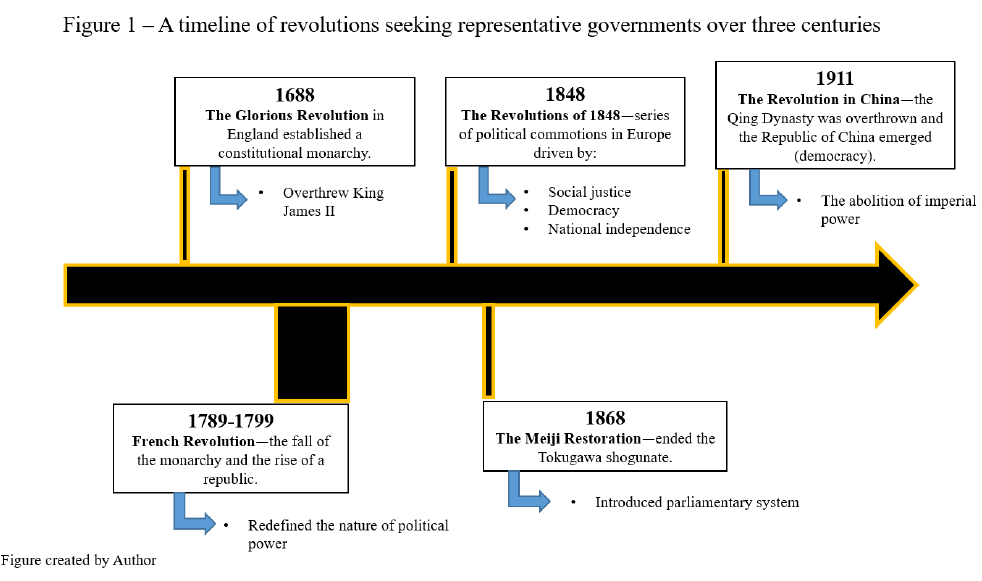
Beyond the UK and the US, the notion of representative democracy proves inspiring to other nations. For example, John Locke, an Enlightenment thinker, argued in 1690 that “…the whole power of the community naturally in them, may employ all that power in making laws for the community … and executing those laws by officers of their own appointing; and then the form of the government is a perfect democracy…” (Locke 2015, Sect. 132). In fact, many events in history took place solely upon the desire for a representative government. Figure 1 shows that between 1600s and 1900s each key revolution sought democracy. Furthermore, these revolutions happened around the world involving countries such as England, France, Japan, China and those across continental Europe. This, we can call, a positive democratic spillover.
Towards the last century of the Roman Republic, the functioning of the representative government started to wither because of the increasing association between wealth and governing power. For example, in 113 BC, an elected official, Tiberius Gracchus, attempted to correct a social norm at the time—the unequal distribution of wealth. When King Attalus III of Pergamon died and left his fortune to the people of Rome, Tiberius tried to give the wealth to the poor and was supported by numerous followers. This attack on senatorial power lead to the Senate’s increasing disapproval of Tiberius and political violence followed suit resulting in the death of Tiberius and his followers (Fife 2012). Consequently, the effective democratic system the Romans first introduced failed. This failure seems to have continued to this day as wealth inequality goes hand in hand with populism and socialism in democratic countries (Rachman 2024).
The decay of the Roman Republic created an opportunity for an empire to rise when people desperately need leadership. When the Roman Empire emerged in 27 BC, Augustus Caesar exploited this opportunity by naming himself the emperor (Little 2023). The Emperor governed with the advice of the Senate rather than with the Senate—the Senate was no longer legislative. Even worse, military leaders gained greater political power because the Emperor frequently relied on them (Rogers and Dodge 2005). With militarized governance, the Roman political system, we can argue, evolved to support the emperor’s individual territory ambition using the society’s military assets.
Over two millennia since the Republic, the influence of Roman failures and successes continues. As shown in figure 2, successes (upward arrows) include a long period of influence of democracy including Figure 1 (reproduced on top right). The downward arrows show the failures.
First, unequal wealth distribution and political power, a feature during the Roman period, continues today. According to latest reports (OpenSecrets; Wikipedia 2018), half of the US Congress are wealthy individuals (average net-worth of $50 million), with the wealthiest owning $361 million which is equivalent to an average American’s salary for 5500 years/70 lifetimes. Additionally, research suggests that wealth-equalising policies, similar to that campaigned by Tiberius, are difficult to come into light in a democratic system because voters often disagree how the wealth should be redistributed and the democratic process is usually seized by the rich who would, naturally, refuse equalising wealth (Scheve and Stasavage 2017).
Second, the Roman Empire’s militarism has inspired modern states to purse military supremacy. The Empire sets a historical precedent of successful militarized governance. It develops an integrative infrastructure such as advanced road systems built to support military logistics (Facts and Details 2024) and standing armies4. Militarism refers to “Military attitudes or ideals, esp. the belief…that a country should maintain a strong military capability…Also: a political condition characterized by the predominance of the military in government…or a reliance on military force in political…matters” (OED). Nowadays, strong militarism exists in countries, specifically the G7, considered to have the best democracies but also the greatest wealth accumulation (Rachman 2024).

Third, since Tiberius’ attempt to redistribute wealth to the poor, populism and socialism have become a constant reminder of modern democracies’ problems. Consequently, addressing inequality and poverty is a global priority. For example, Sachs (2005) argues in his acclaimed book ‘The End of Poverty’ that the solution to inequality is global governance. Recent evidence suggests that wealth inequality persists through the past centuries but wealth concentration decreased in recent decades—caused by a combination of higher marginal tax rates and better democracy (Roine and Waldenström 2015).
In conclusion, the most significant influences of the Romans on modern political systems are as follows. First, its introduction of representative government creates a structure of power distribution increasing order and efficiency and this model has positively influenced countries globally. Second, the association between wealth and governing power, which caused the Republic’s democracy to wither, gives rise to populism and socialism. Third, the Roman Empire’s militarized governance has inspired modern-day states to pursue military supremacy. Fourth, modern political systems continue to struggle to resolve inequality which first emerged from the end of the Roman Republic. This essay concludes that the Romans’ legacy, from its successes and failures, remains in the DNA of modern political systems. The knowledge we gain from critically analysing the Romans’ influences can help us understand how to grow from not only successes but also failures which have, sadly, been repeated for millennia.
Bibliography
Ancient-Peoples (2024) How Did Ancient Rome Government Influence The Modern World. Ancient Peoples, URL: https://www.ancient-peoples.com/how-did-ancient-rome-government-influence-the-modern-world/ (accessed October 12th, 2024)
Britannica Representative Democracy, Available at https://www.britannica.com/topic/representative-democracy (accessed 28 November 2024).
Facts and Details (2024) Ancient Roman Infrastructure. URL: https://factsanddetails.com/world/cat56/sub408/item2053.html (accessed 29 December 2024).
Fife S (2012) The Brothers Gracchi: The Tribunates of Tiberius & Gaius Gracchus. World History, URL: https://www.worldhistory.org/article/95/the-brothers-gracchi-the-tribunates-of-tiberius–g/ (accessed 26 December 2024).
Little B (2023) How Rome Destroyed Its Own Republic. HISTORY, Last Updated July 27, 2023. URL: https://www.history.com/news/rome-republic-augustus-dictator (accessed 26 December 2024).
Locke J (2015) The Second Treatise of Civil Government. Canada: Broadview Press.
National Geographic, Rome’s Transition From Republic To Empire, https://education.nationalgeographic.org/resource/romes-transition-republic-empire/ (accessed 27 October 2024).
OED (Oxford English Dictionary) Available at http://www.oed.com (accessed 23 December 2024).
OpenSecrets (2018) Net Worth -2018. URL: https://www.opensecrets.org/personal-finances/top-net-worth (accessed 29 December 2024).
Rachman G (2024) The world’s leading democracies are struggling to govern. Financial Times. URL: https://www.ft.com/content/ea15bed8-bb4d-4e55-880f-a0ed4f2ef8b6 (accessed 29 December 2024).
Rich J and Shipley G (1993) War and Society In The Roman World. London: Routledge
Rogers N and Dodge H (2005) Rome The Greatest Empire. London: Southwater.
Roine J and Waldenström D (2015) Long-run trends in the distribution of income and wealth. Handbook of income distribution, 2, pp.469-592.
Scheve K and Stasavage D (2017) Wealth inequality and democracy. Annual Review of Political Science, 20(1), pp.451-468.
Speidel M A (2013) The Encyclopedia of Ancient History – “Army, Roman Empire”.
Taylor D W (1980) Roman Society (Inside the ancient world). Singapore: Nelson.
5
UK Parliament (2017) The Legislative Process: Preparing Legislation for Parliament Contents, Chapter 4: The quality of legislation. URL: https://publications.parliament.uk/pa/ld201719/ldselect/ldconst/27/2707.htm (accessed 29 December 2024).
UK Parliament, The two-house system, https://www.parliament.uk/about/how/role/system/ (accessed 20 November 2024)
Wikipedia (2021) List of current members of the United States Congress by wealth. URL: https://en.wikipedia.org/wiki/List_of_current_members_of_the_United_States_Congress_by_wealth (accessed 29 December 2024).

 The GSAL Journal