

Shaurya (Year 12)
Editor’s note: Year 12 student Shaurya entered this essay into the John Locke Global Essay Prize 2025 in the Economics category. He addresses the questions: What kinds of behaviour are engendered by the hope of profit? Is such behaviour better or worse, on balance, than the behaviour we should expect if all enterprises were owned by charities or governments? The judges short-listed Shaurya’s work from over 63,000 entries across all subject areas. He is invited to an awards evening in London where the winning entries will be announced. CPD
Profit is the driving force that keeps economies functioning. It is the reward for successful entrepreneurs, and it leads to higher quality of life and financial growth. Across the globe, people innovate and take risks with the hope of profit. Usually, this also benefits consumers due to more business activity. However, does this behaviour always align with the interests of common people? The classical capitalist model suggests this, but I will be investigating if this is practically true in the modern world.
Classical thinkers such as Adam Smith advocated for free-market economies and laissez faire governments1. This is because they believed that a market would regulate itself if all economic agents rationally seek profit. For example, a building contractor would want to reduce their staff wages to reduce costs and increase profit. However, this would mean that the staff would leave and work for another building contractor who offers better wages. This would put the first building contractor out of business due to a lack of staff. Therefore, they pay a certain wage so that both the contractor and the employees are happy. This is known as the invisible hand mechanism2. The same phenomenon occurs in all business transactions, ensuring that all parties are satisfied with the deal.
Furthermore, the underlying requirement for the invisible hand mechanism to work is competition, which is also driven by desire for profit. Entrepreneurs are motivated to take risks and open businesses for financial reward, leading to more competition in markets. In turn, this means that all businesses try to innovate and increase quality to gain unique selling points. The result is that consumers are exposed to products of higher quality, benefitting their livelihoods. In certain industries such as food and pharmaceuticals, this can go as far as to save lives. On the other hand, there would be less motivation to provide the best possible good/service if all enterprises were owned by charities or governments.
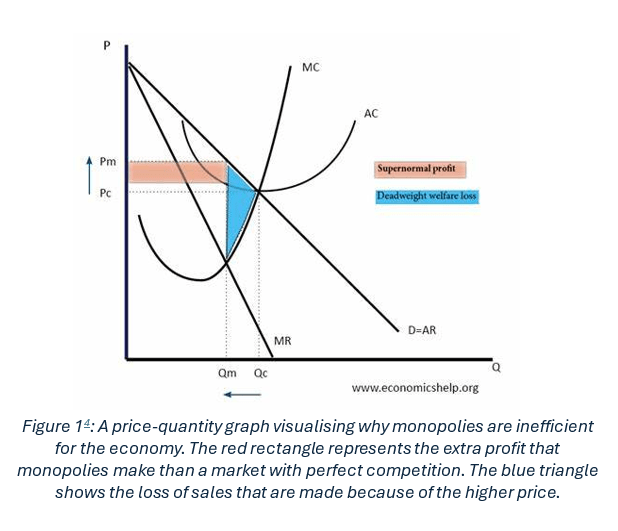
While this seems foolproof in theory, are there any problems when it occurs in the real world? For example, what would happen if multiple competitors merged to form a monopoly over a market3? This would mean that employees would have no other place to work if they are mistreated, giving the business too much power. The same occurs for consumers; they have no other place to buy goods or services if quality is unsatisfactory or prices are too high. The result is that the owners of the corporation enjoy high profits while all other stakeholders suffer.
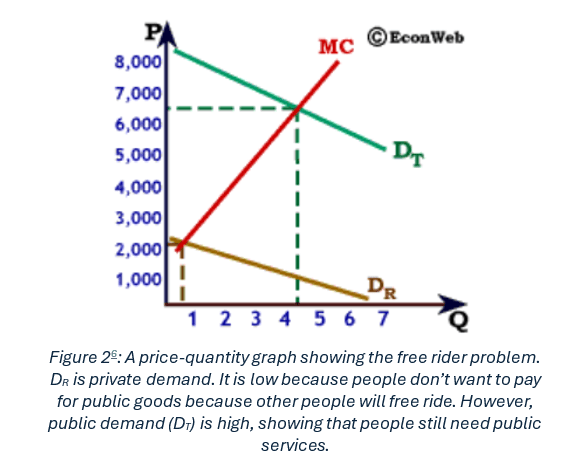
Another issue with this model is the free rider problem. This is a type of market failure which arises when everyone can benefit from a resource in unlimited amounts, nobody can restrict others from using it and only a few people contribute to the costs of the resource5. An example of this is street lighting. In a community, everyone benefits from streetlights when travelling in darkness. They ensure that you can see the road and the curb, reducing the risk of accidents. However, only one organisation pays for streetlights: the government. This is because no profit-driven businesses would be motivated to pay for streetlights as they cannot make revenue from it. This principle applies to many types of infrastructure which are vital in the community, such as roads, national defence and criminal justice. Governments and charities are needed to fund these institutions.
Clearly, a governing body is needed to provide public services and control the extent to which businesses go to increase profit. This points to the status quo where most developed countries have mixed economies: economic agents have freedom only to a certain extent. For example, the government can prevent monopolies forming by restricting integration of two businesses if market share exceeds a certain amount. Now, let us compare this with the alternative model where all enterprises are owned by charities and governments.
First, we need to establish the behaviours of charities and governments. The most fundamental purpose of government is to protect their citizens7. They use taxation to make a police force and build infrastructure purely for the citizens’ wellbeing, not profit. If all businesses were publicly owned, they would be much more accessible due to lower prices. The National Health Service in the United Kingdom is the quintessential example of this; healthcare is free for everybody, leading to better wellbeing and public health8. On the other hand, hospitals in other countries are profit-driven, leading to unethical health inequality between the rich and poor. Of course, the UK health system is much more protective of its citizens. Despite this, the public ownership ideology has its flaws.
The overarching problem is increased taxation. Even if UK citizens are more protected, they need to pay higher taxes for it to be possible. In 2023/2024, £188.5 billion ($258.1 billion) was spent on the NHS9. Even more money would be needed by the government if basic needs were given for free. If all enterprises were owned by non-profit organisations, taxes would need to be higher to make it sustainable for the government.
In addition, there are feasibility issues with charities doing enterprise. This is because they exist to support a cause, often humanitarian or environmental. They do not exist to satisfy the needs of customers. Therefore, charities will not be able to fulfil customer demand properly, because it may contradict their mission. For example, a charity that advocates for healthier lifestyles and diets would not want to sell sugary sweets. However, it is possible that a large segment of the market wants to buy sweets, but the charity will not provide them. This causes a missed opportunity for economic activity and unhappy customers.
So far, we can see that a world where all enterprise is non-profit is problematic. Also, an unregulated profit-driven market is not the solution. However, is there anything wrong with the status quo where regulation keeps corporations in check?
First, businesses striving for profit sometimes compromise their corporate social responsibility. Notably, businesses often fail to care for the environment. In current legislation, there is little that prevents businesses from harming the environment. For example, businesses are free to burn fossil fuels and bury non-recycled waste in landfill sites. This is because it is cheaper than the more sustainable alternative which consists of recycling and using renewable energy. Therefore, businesses are willing to harm the environment for lower costs and higher profits. This has a disastrous effect on the climate, harming the future generations. On the other hand, non-profits are likely to have social responsibility as a top priority, so they will be more willing to be environmentally conscious.
Next, excessive desire for profit has led to market failure in the past. The most famous example in recent years is the housing bubble of 2007-2008. Banks realised that they would earn more profit by drastically increasing the volume of mortgages that are given, disregarding quality. They then started offering subprime mortgages to anyone who wanted to buy a house, despite many not having any way of paying it back. Even the rating agencies gave superfluously positive ratings to the risky securities because they wanted more profit. When the bubble burst, a domino effect ensued. Two million American jobs were lost in the last four months of 200810, and the global economy became stagnant. This is one of many historical examples where greed has led to catastrophe.

As you can tell, both worlds have their drawbacks and no situation is perfect. However, which is better on balance? Because of the free rider problem, a world where all economic agents are profit-driven is infeasible. However, the opposite is far from ideal; public ownership strips all motivation for innovation and progress, leading to a stagnant society. Is the status quo the perfect option? Well, I believe that both profit-driven corporations and non-profits coexisting is the correct way of resolving the clash, but that does not mean that the status quo is the best we can do.
With a mixed economy, there are still corporations which are profit-driven, leading to innovation and change. These corporations provide most goods and services, satisfying customer needs. Also, governments and non-profits exist, who are responsible for providing public services, enforcing regulation and advocating for social responsibility. This solves the free rider problem and prevents the risks associated with free markets such as monopolies. There is only one issue left: how do we solve the problem of profit-driven businesses neglecting ethical and environmental considerations? After all, the 2008 fiscal crisis would have likely been avoided if banks had thought about the long-term consequences of their actions.
Extra legislation may be the solution. For example, businesses could be required to fulfil environmental quotas by law. If they do not, they will receive a fine and reputational damage. This would provide a strong motivation for businesses to care for the environment, helping them be more responsible. Similarly, laws may be passed to prevent market exploitation, which has worked in the past. After the housing bubble, the Dodd-Frank Wall Street Reform and Consumer Protection Act12 introduced tighter restrictions on the activity of the financial sector. Crucially, banks were prohibited from taking part in proprietary trading and were required to maintain higher liquidity. This has prevented any further financial crises since.
Despite legislation being a powerful motive, it is better at stopping situations from repeating rather than preventing them in the first place. For that, the public has the power. If everyone starts choosing businesses with positive ethical and environmental practices, this provides the ultimate motive for corporations to become more responsible.
To conclude this essay, I would like to highlight that the motivation for profit is paramount for society to function and develop. Even though non-profit ownership has short-term benefits for public welfare, it ultimately fails to give the motivation for long-term societal progress and personal achievement. Which is better: making someone satisfied in the short-term or providing motivation for long-term success? In addition, it is not solely the corporations’ role to be responsible about their actions to do with profit. Every one of us has the power to harness the universal desire for profit for good. Whether that be buying sustainable alternatives or advocating for ethical decisions, the choice is ours.
Endnotes
- Young, Julie. 2024. “Classical Economics and the Evolutions of Capitalism.” Investopedia. July 25, 2024. https://www.investopedia.com/terms/c/classicaleconomics.asp
- “Unlocking Adam Smith’s Invisible Hand: A Deep Dive into Economic Theory.” 2025. Socialstudieshelp.com 2025. https://socialstudieshelp.com/economics/adam-smiths-invisible-hand-explained/
- Hayes, Adam. 2024. “What Is a Monopoly? Types, Regulations, and Impact on Markets.” Investopedia. June 21, 2024. https://www.investopedia.com/terms/m/monopoly.asp
- Tejvan Pettinger. 2019. “Diagram of Monopoly | Economics Help.” Economicshelp.org. July 28, 2019. https://www.economicshelp.org/microessays/markets/monopoly-diagram/
- Rasure, Erika. 2020. “Free Rider Problem.” Investopedia. 2020. https://www.investopedia.com/terms/f/free_rider_problem.asp
- “Microeconomics – Public Goods – Free Rider.” 2025. Econweb.com. 2025. https://www.econweb.com/Sample/PublicGoods/FreeRider4.html
- World Economic Forum. 2017. “3 Responsibilities Every Government Has towards Its Citizens.” World Economic Forum. February 13, 2017. https://www.weforum.org/stories/2017/02/government-responsibility-to-citizens-anne-marie-slaughter/
- NHS England. 2021. “NHS England» an Introduction to the NHS.” http://www.england.nhs.uk. 2021. https://www.england.nhs.uk/get-involved/nhs/
- Arnold, Sarah, and Danielle Jefferies. 2025. “The NHS Budget and How It Has Changed.” The King’s Fund. March 25, 2025. https://www.kingsfund.org.uk/insight-and-analysis/data-and-charts/nhs-budget-nutshell
- The Plain Bagel. 2019. “The 2008 Financial Crisis – 5 Minute History Lesson.” YouTube Video. YouTube. https://www.youtube.com/watch?v=eD9ry2Lgglw
- Gaudet, Monica. 2017. “2008 Financial Crisis.” My CMS. May 3, 2017. https://bmg-group.com/2008-financial-crisis/
- Ross, Sean. 2024. “Major Regulations Following the 2008 Financial Crisis.” Investopedia. April 30, 2024. https://www.investopedia.com/ask/answers/063015/what-are-major-laws-acts-regulating-financial-institutions-were-created-response-2008-financial.asp
Bibliography
Arnold, Sarah, and Danielle Jefferies. 2025. “The NHS Budget and How It Has Changed.” The King’s Fund. March 25, 2025. https://www.kingsfund.org.uk/insight-and-analysis/data-and-charts/nhs-budget-nutshell
Gaudet, Monica. 2017. “2008 Financial Crisis.” My CMS. May 3, 2017. https://bmg-group.com/2008-financial-crisis/
Hayes, Adam. 2024. “What Is a Monopoly? Types, Regulations, and Impact on Markets.” Investopedia. June 21, 2024. https://www.investopedia.com/terms/m/monopoly.asp
NHS England. 2021. “NHS England» an Introduction to the NHS.” Www.england.nhs.uk. 2021. https://www.england.nhs.uk/get-involved/nhs/
Pettinger, Tejvan. 2020. “Explaining Supply and Demand.” Economics Help. February 25, 2020. https://www.economicshelp.org/blog/160660/economics/explaining-supply-and-demand-2/
Rasure, Erika. 2020. “Free Rider Problem.” Investopedia. 2020. https://www.investopedia.com/terms/f/free_rider_problem.asp
Ross, Sean. 2024. “Major Regulations Following the 2008 Financial Crisis.” Investopedia. April 30, 2024. https://www.investopedia.com/ask/answers/063015/what-are-major-laws-acts-regulating-financial-institutions-were-created-response-2008-financial.asp
Singh, Manoj. 2024. “The 2007-08 Financial Crisis in Review.” Investopedia. Investopedia. August 25, 2024. https://www.investopedia.com/articles/economics/09/financial-crisis-review.asp
Tejvan Pettinger. 2019. “Diagram of Monopoly | Economics Help.” Economicshelp.org. July 28, 2019. https://www.economicshelp.org/microessays/markets/monopoly-diagram/
The Plain Bagel. 2019. “The 2008 Financial Crisis – 5 Minute History Lesson.” YouTube Video. YouTube. https://www.youtube.com/watch?v=eD9ry2Lgglw
World Economic Forum. 2017. “3 Responsibilities Every Government Has towards Its Citizens.” World Economic Forum. February 13, 2017. https://www.weforum.org/stories/2017/02/government-responsibility-to-citizens-anne-marie-slaughter/
Young, Julie. 2024. “Classical Economics and the Evolutions of Capitalism.” Investopedia. July 25, 2024. https://www.investopedia.com/terms/c/classicaleconomics.asp
Anon. “Microeconomics – Public Goods – Free Rider.” 2025. Econweb.com. 2025. https://www.econweb.com/Sample/PublicGoods/FreeRider4.html
Anon. “Unlocking Adam Smith’s Invisible Hand: A Deep Dive into Economic Theory.” 2025. Socialstudieshelp.com. 2025. https://socialstudieshelp.com/economics/adam-smiths-invisible-hand-explained/

 The GSAL Journal