
Lokesh (Year 9)
Editor’s note: Now in Year 10, talented student Lokesh carefully researched this topic and then wrote this insightful essay for the Sir Martin Gilbert History Prize. This essay explores Britain’s response to Jewish refugees during the Nazi period, analyzing various perspectives and sources to assess whether Britain was truly welcoming or reluctant. Britain’s actions included both welcoming efforts, such as the Kindertransport, and widespread societal hostility, suggesting a complex and ambivalent response to Jewish refugees during the Nazi period. CPD
Imagine this: It’s 6:00 pm in Warsaw. Waves of terror flow through the city, once a placid and peaceful place, but now one filled with prejudice, with hostility, with a vile party that will stop at nothing to get what they want. The Nazi Period was a time of turmoil for all people all over the world, causing seventeen million people to fall before the feet of the Nazi Party like leaves in a storm. In the face of Nazi terror, Britain became a sanctuary of over 80,000 Jewish refugees. However, is the idea of a warm Jewish welcome a myth or a true tale? In this essay, I will explore how Britain responded to Jewish refugees during the Nazi period, first covering how the Kindertransport showed the approach of Britain towards Jewish refugees, and then will move on to analyse primary sources from refugees and journalists at the time. After that, I will look at accounts of Jews living in Britain and focus on newspapers written at the time to view the opinions of the whole region. Finally, I will give a judgement that gives my take on this highly debated topic. What say did Britain have in this piece of history? Was the nation truly a welcoming home or a reluctant host?
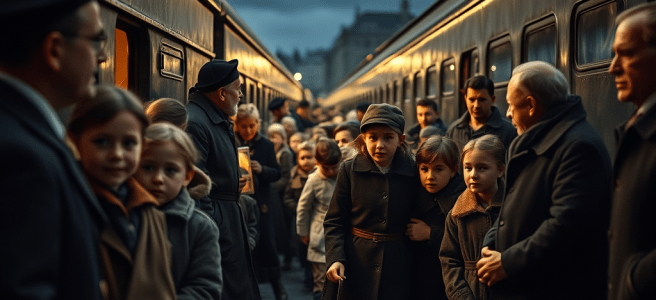
Some may say that using the word ‘welcomed’ to describe the way Britain acted towards refugees is an understatement. But to see why, we have a long journey back to 1938, when trouble was brewing in Europe. Anti-Semitic attacks, like on Kristallnacht, were taking place, the Jews in waiting of a hero. And one came. Britain ordered a mission, called Kindertransport, to rescue the Jewish children from parts of Europe controlled by the Nazis, hoping to revitalise their lives and give the Jewish society new hope. Around 10,000 Jewish children were taken from the hands of the devil and were welcomed onto UK soil for their first times, all thanks to the UK government.
Thanks to the Kindertransport, it is as clear as daylight that the Jews were welcomed to Britain during the Nazi period. How can you say that Britain themselves saving the Jews from the jaws of their doom isn’t welcoming? Britain showed that they were welcoming towards the Jews because they rescued them and let them live fantastic lives when other countries, such as the U.S, had strict immigration policies and did not let the Jews in.
Not only this, the Kindertransport highlights the considerate and welcoming nature of Britain in other light. The primary goal of Kindertransport was to rescue only children. This act of preserving the Jewish children might show Britain’s thought for the Jewish future because it shows us that Britain cared for the future of the Jewish community. Do you really think that this Jewish generation would be the same without the help that Britain gave to these Jewish children? Britain showed their care through forward-thinking, and they clearly looked out for the Jewish community.
Now, I would like to examine a source from the time of the Kindertransport; a newspaper page, that is a primary source, written by journalist A. L. Easterman, who wrote this issue of the Daily Herald. An image of the source is attached below:
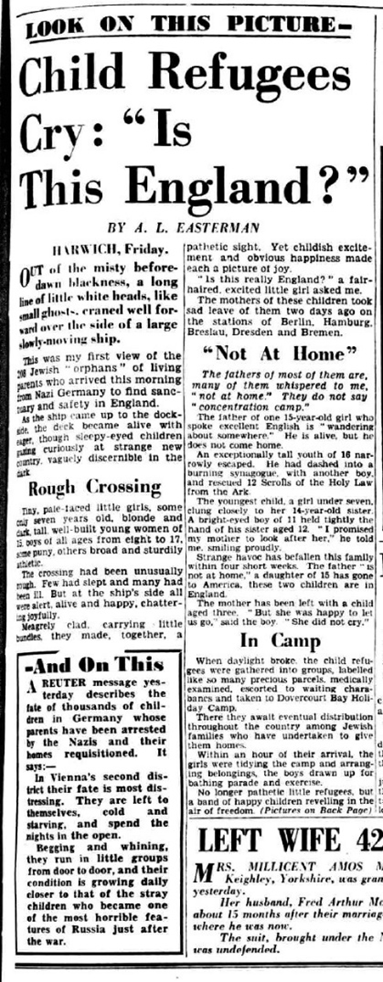
The source suggests that Jewish refugees were treated pleasantly by the British people. A. L. Easterman says that “Within an hour of their arrival, the girls were tidying the camp and arranging belongings, the boys drawn up for bathing parade and exercise.” The fact that “within an hour” the children already fit in shows that the British people clearly welcomed them into society and made them feel like they were at home. The refugees are described by him to be “No longer pathetic little refugees, but a band of happy children revelling in the air of freedom.” Wouldn’t you agree that a “band of happy children” clearly shows that the British were treating the Jews kindly and with respect? As we know, this suggests that they had an outstanding quality of life, meaning that they must have been provided with countless toys and tantalising food. They are described to have “freedom” which shows the British people let them revel in the moment and do whatever they wanted, showing their welcoming nature. It is obvious that overall, this extract shows how nicely the refugees were treated. The luxurious lives that they were given out of the kindness of Britain must be because of their kind and welcoming nature.
But we historians must look deeper. Why might A. L. Easterman have had these thoughts and written this response? Well, for several reasons. The author was an owner of a Jewish refugee himself, showing that he undoubtedly would have seen the housing units and been with the refugee inside, confirming the truth of the account. On the other hand, the author was the political director of the World Jewish Congress. Maybe, with his article, he was trying to influence more people to adopt the Jews, or was trying to send an optimistic message back to all the apprehensive parents in Europe? Only history can tell the true tale.
Another source written during the Nazi period is a first-person letter written by Marianne Mosevius, a 15-year-old Jewish girl given a place in a holiday camp in Britain, sent to her parents. In this letter, which was originally written in German, she gives strong sentiments on how her life is in Britain. For the link to the letter, click here.
Marianne opens discussion on how her life is in the camp that she is staying in by saying “It’s wonderful here!!!” which shows Britain was welcoming to Jews because her life in Britain must have been wonderful, the people taking great care of her for certain. In addition, the letter goes into detail on the camp. Marianne describes how “everything is cheerful and colourful”, talking about the “rooms of their own”, and saying that the “food is good”. On the topic of her room, she describes how lovely it is, telling us about all the ornate things, such as the “pretty folding chair” and the bed that is “as wide as a double bed”. The fact that Marianne is provided with such an amazing quality of life in contrast to her dreary one in Europe shows the care Britain had in flipping the lives of many, and her welcome to Britain is nothing but warm with all the cordial things she is given. Wouldn’t you agree that, from this account, Britain were welcoming to the Jewish refugees and made them fit in? In my opinion, the British people went out of their way to give a kindling, warm welcome to the Jewish refugees.
On the other hand, can you really say that Britain was welcoming when they showed a massive amount of hate to Jews? One example of this is the front page of the “Action”, which was a weekly newspaper run by the British Union of Fascists. An image of this front page is inserted below:
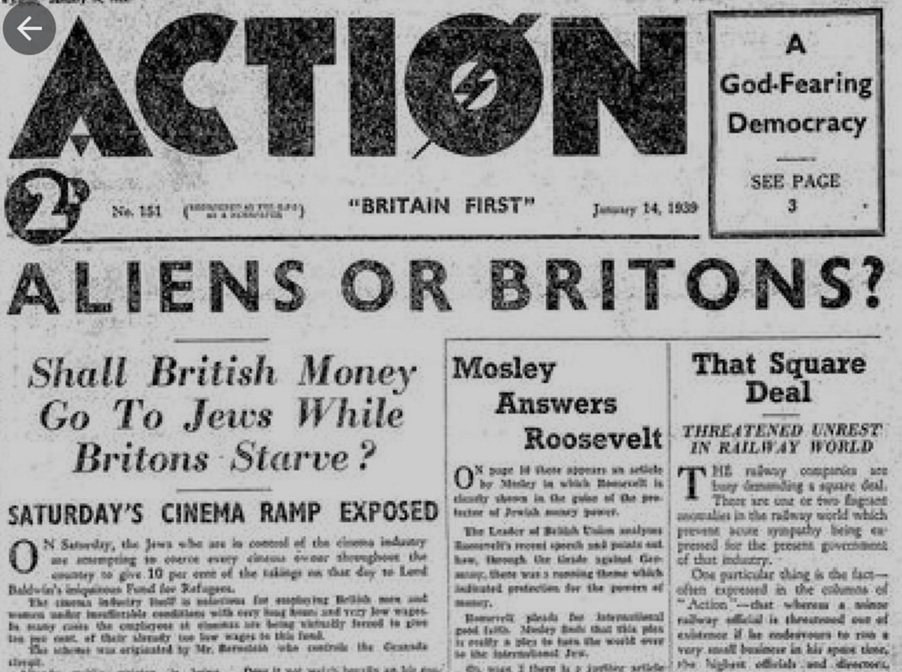
Although most of the small-print text is not legible, the title is, saying “Aliens or Britons” and “Shall British Money Go To Jews While Britons Starve?” This title clearly illustrates the cold and callous attitude of British people towards the Jews. The newspaper title clearly influences people to treat the Jews like “aliens” and we can both agree that this will have outcasted them from society and made them feel quite the opposite of welcomed. The newspaper title also emphasises that Britons should not give kindness or money to Jews, clearly and convincingly telling people to only care about themselves and other Britons and not to show respect to the Jews. But how might this have affected the Jews? Well, we can suspect that the effects of this newspaper were widespread. Because the newspaper is likely to have been sold in newsagents, on the streets, and shared between friends, families, and public, there is no denying that many people would have seen it, read it, and understood its messages. Many people were influenced by this newspaper, and consequently may have treated the Jews badly, not showing any respect to them and were cruel and unkind towards them. How can you say that this is welcoming from Britain? This sort of attitude is not welcoming, but Britons were instead cold, callous, and unforgiving towards the Jews during the Nazi period.
Secondly, I would like to move from the child’s account of life I used at the beginning of my essay onto an account of a woman who went to live in Britain from Europe. Käthe Kupferberg wrote an account of the events she had experienced in Britain, which was written in April 1940. An image of the account, translated into English, is below:
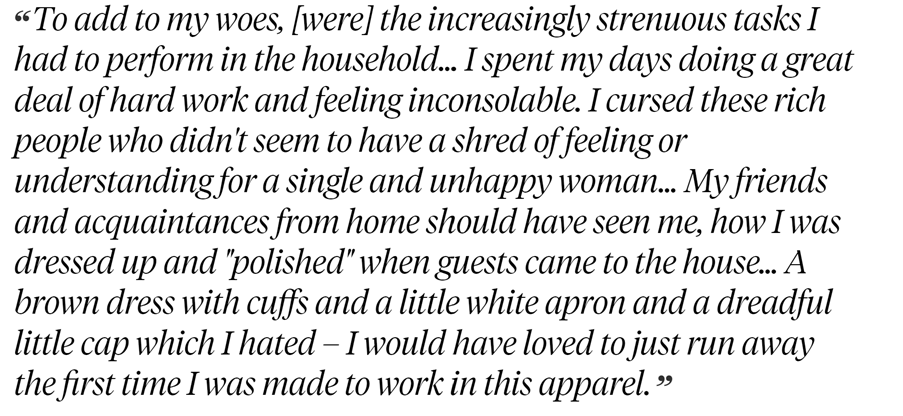
In the extract, the feeling of sadness and disappointment is portrayed so clearly. Käthe must do so many “strenuous tasks” and did a “great deal of hard work”, which shows that the people in Britain took advantage of her vulnerability instead of showing sympathy, with what she went through in Europe. She had to do so much arduous work which is not fair and portrays a cruel and unwelcoming Britain. Not only this, but Käthe clearly says that nobody in Britain cared for her or welcomed her, saying that she was angry with “these rich people who didn’t seem to have a shred of feeling or understanding for a single and unhappy woman.” Isn’t it clear from this quote that there was absolutely no kindness shown or help given to this woman who has undergone so much trouble? Why did nobody show sympathy or consideration to her, or at least be kind and helpful? Even a fool would understand that a kind and welcoming Britain is not compatible with this sort of life that Käthe was living.
In conclusion, I believe that Jewish refugees were not at all welcomed to Britain during the Nazi period, but were instead treated poorly, with no respect shown and no kindness and consideration whatsoever. Although the children were treated kindly, one can argue that sympathy would have caused this response, because the British public swayed the opinion of the government, and this meant that Kindertransport was initiated. Instead, the adults were treated so badly. They were taken advantage of by the people they worked for and were forced to work a lot harder than any other Briton. They were treated like dirt, and nobody showed a “shred of feeling or understanding” to them, proving that the Britons were cruel and inconsiderate to the Jewish people. Even newspapers, such as The Action were not afraid to show this message, publicising it left, right, and centre, and saying that Jews were not worth any time and care and should not be treated with respect. Wouldn’t you agree that this clearly would have influenced people to treat Jews badly? Do you think that this response from Britain is welcoming in the slightest? Well, while Britain did welcome the Jews to some extent, such as going out of their way to rescue Jews from Europe with Kindertransport, and giving the next generation of the Jews great lives, where they were “no longer pathetic little refugees, but a band of happy children revelling in the air of freedom”, I think that the cruel attitude that Britons held at the forefront clearly outweighs these acts, and I think many more people were treated poorly than kindly, cancelling out the acts that Britain did involving immigration policies and Kindertransport. In my opinion, they could have done a lot more to welcome the Jews, such as giving them better homes, and more funds to give them a better start to their lives. Therefore, I believe that Jewish refugess were not welcomed to Britain during the Nazi period, but instead faced a cold and callous British society.
Bibliography
https://www.lbi.org/collections/kindertransport-additional-resources-and-links/
https://www.history.com/news/holocaust-child-refugees-kindertransport-britain
https://www.britannica.com/topic/The-Holocaust-Facts-and-Figures


