
Seetal, Annabella, Arsh, Jasmine, Krishay, Kathryn, Kiran and Leah (Year 7 Students)
Editor’s note: Year 7 students, including members of GSAL’s very own 2008 Society (critical thinking), have been busy writing short articles on particular areas of interest as part of their Year 7 Challenge. Some of these articles have also been entered into essay competitions, demonstrating a superb level of engagement in wider academic extension opportunities. You can view other work published as part of the Year 7 Challenge 2024-25 here. CPD
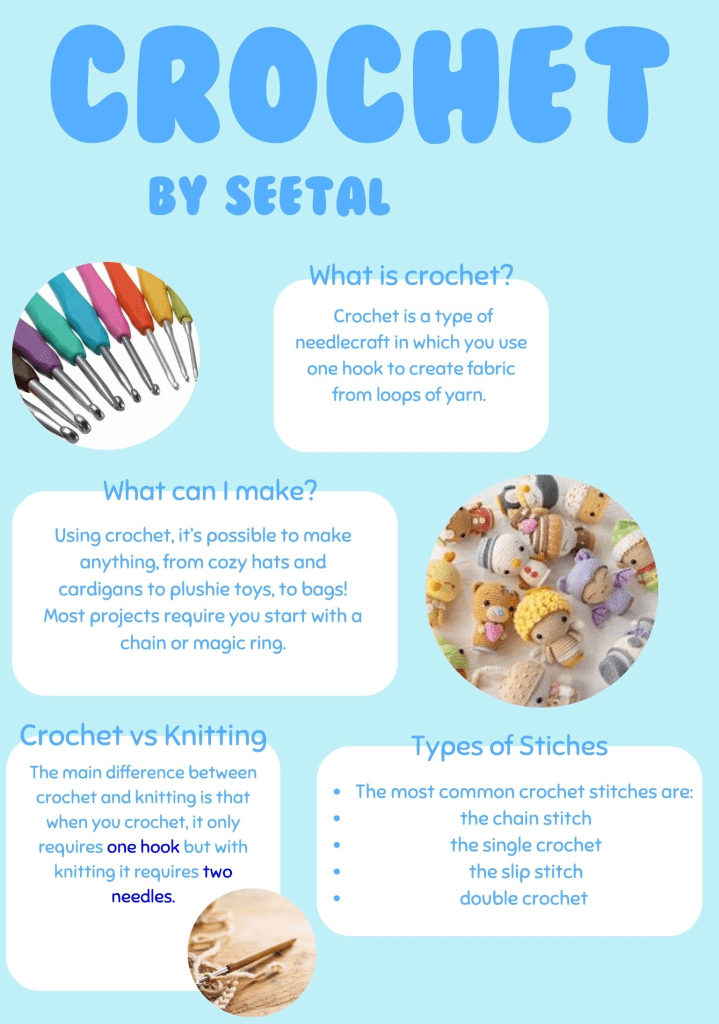
A visual guide to crochet
Seetal (2008 Society member)
Is a world without borders possible and should it be pursued?
Annabella – this essay was also entered into the Minds Underground Young Minds Competition
Imagine a world without borders. Happiness rates increasing, job opportunities increasing, support for the less fortunate increasing and communication between diverse cultures increasing. On the other hand, imagine a world without borders. Crime rates increasing, invasion rates increasing, possibility of war increasing and unethical judgement increasing.
Borders have proved to be substantial in world peace and political decisions, making them a huge part of human history and life. However, many have questioned whether they are needed, and some believe that society would thrive better without them.
Some may say that a world without borders would lead to an imbalanced world and higher rates of war and invasion, however, a world without borders could lead to better connections between communities. This would positively impact people worldwide. The NHS states that building connections – not only with friends and family, but the wider community – is vital for good mental health as it boosts happiness levels and self-worth. Another reason having good connections between communities is important is to understand the views of others and make fair compromises to solutions, that please everybody. Without borders people may become more open to this, leading to a less judgemental society, and putting a stop to major world issues involving the exclusion of individuals due to their differences.
Another reason why a world without borders could benefit communities worldwide is that more job opportunities would open. This would mean that students in sixth form may find the job they want to pursue more accessible or even discover a new profession entirely that they are interested in. This means that students will find it easier to source and work in a job that they are interested in and get reasonable payment faster, meaning that they can pay for a house or apartment sooner in their adulthood. providing shelter and care for a future family. Another group of people that would benefit from new job opportunities is those who are struggling for money and need a job that is better paying. Having no borders would open job options across the globe and lower travel prices, so if someone wanted to have a job in a different area, they could move to that area easily and cheaply.
On the other hand, although more job opportunities and higher amounts of communication would benefit society, the downsides of a world without borders could tear communities apart. An example of this is if a world had no borders, different groups of people with different political views could create conflict and war between each other due to wanting to take over areas of land. This is shown by history going back to the first humans, particularly shown in the medieval times when rulers fought over land, this led to war and deaths among soldiers and kings at the time. If borders were removed, this history has the chance of repeating itself and even being more tragic. War could also be created by exclusion of people’s access to materials and education. In a world without borders who would own materials that only grow in certain parts of the world? Who would be entitled to better education than others? The answer to these to questions may lie in the amount of money a group of people or individual owns; however, this brings us to another point on the money system. As across the world there are different types of money and the cost of living varies in every country, how would we be able to work out which system of money is the most efficient? From pounds in the UK, to euros in the majority of Europe, to dollars in the USA or to yen in Japan, all currencies are different and have their own ways of functioning. These differences in currencies would cause major problems in the market of trading, which has been an important part of human society for centuries. With borders, traders can work out which currency they are receiving for what they are selling.
A world without borders could create a negative impact in relation to religion. Due to some religious beliefs contradicting each other this would be another cause of conflict between people. You may think that this could happen with borders however removing borders would increase the likelihood of religious conflict due to anyone being able to enter any area at any given time. Religious conflict could be harmful to society and religious believers. An example of this is The Crusades, where in the 1st Crusade it is likely that the number of deaths exceeded 100,000. This shows that religious conflict can be very serious. Keeping a world with borders could help prevent conflict such as this from happening again.
On another point, a world without borders would increase crime rates due to the same reason it would start more religious conflict – the ability for a given person to go anywhere at any time. Crimes such as theft, vandalism and murder would become more common and as different countries have different ways of handling crimes and punishing committers, society would have no clear way of punishing or trialling suspects.
In conclusion, a world without borders could have a positive impact on society however I believe that borders help the world remain more peaceful and prevent conflicts in society. A world without borders could be possible however it would be highly difficult to organise, and I believe the negatives outweigh the positives in this case. In my opinion, the positives are not worth the amount of effort and time it would take to create a world without borders and many people would be against the cause leading to a divided society when the idea is trialled, making the negatives even more problematic.
Can Artificial Intelligence replace human doctors in the next 50 years?
Arsh
From MRI (Magnetic Resonance Imaging) machines to ventilators, the human world has been using computers to run machinery like this in healthcare for decades, but when will it be time for a new age of medical apparatus? Doctors have relied on computers for nearly every scenario in various parts of the hospital across the world. For example, how could doctors find the exact nature of the problem with patients if the computer in the MRI could not generate detailed images of the internal structure of the patient’s organs? Similarly, the ultrasound machine looks at various structures and functions of the heart, which is impossible if the technology needed does not exist. So, maybe it is time for a new era of Artificial Intelligence (AI) to begin. AI which can not only diagnose problems but also continue to learn without the help of human expertise. This essay will explain some of the pros and cons of AI’s rise within the walls of one of the most lifesaving buildings ever built. The hospital.
AI in hospitals can be used for a wide range of applications. In 2024, the BBC published an article titled: Hospitals will use AI to speed up patient care. The article says that “AI software will be used to prepare X-ray reports and read blood test results”. It also states that “bosses have pledged rapid assessments in emergency departments, more home-based treatments and virtual wards” This could make pre-booking for hospital appointments nearly 2 months in advance cease to exist and could eliminate complaints from people whose appointments were never booked even though they asked for an appointment due to human error. The primary reason why people’s appointments are never booked is because of how people find appointments too difficult; some people are worried about the burden on the NHS and some people are even worried about catching diseases! But if AI comes along, people will realise how quickly AI can book and speed up appointments. This will make the system go much faster and keep helping people who need appointments more than others.
AI in hospitals can also be used for drug discovery. This development process is often lengthy and expensive. AI is speeding up this process and reducing the time and cost associated with bringing new drugs to market. As an example, say a new drug came into the market which could help children suffering from malaria, but the doctors didn’t know what the side effects could be, and this is where AI steps in. AI could determine the side effects beforehand, and if they couldn’t quite do that, they could help identify ideal candidates for clinical trials.
So, after these pros, what could be better than putting our trust in AI which could diagnose problems in time by just speeding up appointments or saving millions of people’s lives with one simple drug discovery? But what would happen if the world’s hospitals were filled to the brim with just AI? These next paragraphs will explain some of the cons of AI in our hospitals.
One of the cons of AI within medicine is that inaccuracies are still possible. Medical AI depends largely on diagnosis data available from millions of catalogued cases. In cases where little data exists on illnesses, demographics or environmental factors, a misdiagnosis is entirely possible, whereas doctors with years of training know how to extract information on cases where almost no data exists, or even zero data. Because some AIs in the hospital probably won’t be the most reliable, and they will not be able to do the work and copy the methods that doctors who studied for many years in university can execute. Similarly, AI cannot show the kind nature of interaction that could help determine the diagnosis of the patient during a face-to-face consultation. Being with a person would be more ideal than sitting face to face with a computer. Furthermore, AI can also lead to unemployment. It may help cut costs and reduce clinician pressure; it may also make some jobs redundant. This may cause distress with displaced professionals who invested time and money in healthcare education, presenting equity challenges. A 2018 World Economic Forum report projected AI would create a net sum of 58 million jobs by 2022. However, this same study finds 75 million jobs will be displaced or destroyed by AI by the same year. The major reason for this elimination of jobs opportunities is, as AI is more integrated across different sectors, roles that entail repetitive tasks will be redundant. Though AI promises to improve several aspects of healthcare and medicine, it’s vital to consider the social ramifications of integrating this technology.
Going back on connection with patients, the hospital still needs human surveillance. Although AI has come a long way in the medical world, human surveillance is still vital. For example, surgery robots operate logically, as opposed to empathetically. Health practitioners may notice vital behavioral observations that can help diagnose or prevent medical complications. Another one of the cons of AI in the hospital is that it may overlook social variables. Patients’ needs often extend beyond immediate physical conditions. Social, economic and historical factors can play into appropriate recommendations for patients. For instance, an AI system may be able to allocate a patient to a particular care center based on a specific diagnosis. However, this system may not account for patient economic restrictions or other personalized preferences. Privacy also becomes an issue when incorporating an AI system. Brands like Amazon have free reign when it comes to collecting and leveraging data. Hospitals, on the other hand, may face some setbacks when attempting to channel data from Apple mobile devices, for instance. These regulatory and social restrictions may limit AI’s ability to facilitate medical practices.
In conclusion, AI is a rapidly evolving field of computer science that dates all the way back to 1951. Its technological advancements are amazing and are not just confined to healthcare, but to nearly every aspect of the modern world. From an AI defeating a world chess champion in 1997, Siri in our pockets and Alexa in our homes, AI has come a long way from its humble beginnings. If I was suffering from a minor health problem, I would put my trust with AI entirely, but when it comes to an operation, I would find it easier to put my trust in surgeons who have had experience in their field for a considerable amount of time. After all, “health is wealth”.
Should technology have limits?
Jasmine – this essay was also entered into the Minds Underground Young Minds Competition
In today’s rapidly advancing world, technology is slowly taking control of our lives; from smartphones to social media and artificial intelligence, technology is everywhere. Constant advancements will eventually lead to concerns and negative impacts that we will encounter in our society and while technology is essential for the future, I believe there should be limits on its development to ensure that it has a positive impact and does not lead to harmful outcomes.
It is very clear that technology has helped society to advance. However, we need to be mindful that our desire to achieve immediate gratification should always be tempered with the threat of harm to our population. There is an inherent threat that our society will be overly reliant on technology and artificial intelligence meaning that there will be massive disruption if there are cyberattacks or technological failures. This has been evident in recent months with banking applications being affected leading to individuals not being able to access their money. Hospitals have also been attacked leading to healthcare record systems being inaccessible to their treating doctors and nurses. Clearly, patients’ lives will be put at risk unless a solution is found.
These are two of a multitude of potential scenarios across the world which could have devastating consequences, both for individuals and also for wider society. There is already much tension across the world with war in Ukraine and in Gaza. The development of “fake news” in recent years, which can clearly be generated using technology, could eventually be the catalyst which sets off a chain of events leading to the onset of World War III.
Speaking to individuals from a different generation, including my parents, it is evident that they spent much more of their time away from screens with the only available device being the household television. Not only did this mean that they were more physically active and therefore fit, the increased social interaction with others did mean that the culture of loneliness present in today’s youth was far less of an issue.
The use of these technology by young people has led to individuals preferring to communicate with friends and colleagues via social media applications often with “text speak”, rather than directly speaking to the other person. I have seen this first hand despite the two people being in the same room as each other. With the continuation of this, the fear is that this will become the new norm and that we will lose the ability to learn how to communicate in person and adapt our style dependent on the situation that faces us.
Smart phones and tablets are perhaps two of the major culprits in today’s society. Social media companies have created applications which are inherently addictive. The algorithms within these programs are able to determine what interests the young person has by monitoring what content is viewed and for how long. The user will then be “rewarded” with more content of a similar nature.
This situation is made worse by the development of “influencers” within the social media world. My parents have often talked to me about role models that they had when they were my age. They would be able to identify with these individuals given that they were generally local to them, knowing about their background, character and principles. In today’s world, influencers will often portray an idealised picture of themselves which will almost inevitably be fake but may be seen as aspirational but unachievable to the child. The other group of influencers are the famous individuals whose every post on social media will be viewed by tens or hundreds of millions of people around the world. Unfortunately, with both these groups, unlike the role models of previous generations, we will never get to know the real person behind the online profile as the likelihood is that we will never meet them in person.
Aside from the increased social isolation and loneliness due to the limited social interaction, our automatic eagerness to compare ourselves with those individuals who we view on social media, means that we are prone to unhappiness, stress, anxiety and even depression. These mental health problems can develop over time and lead to complications in adult life and development of poor coping strategies and other dependencies including cigarettes, alcohol and other hard drugs.
With the increased reliance and dependence on technology devices, in particular social media applications accessed on smart devices, there is a reduction in our ability to think ourselves. Our minds are naturally able to process information, analyse this and make informed judgements as to whether to trust, believe and accept this as true information. I am increasingly of the opinion that our ability to do this is being compromised.
Artificial intelligence has grown in the past few years and is rapidly developing. The potential for disinformation, untruths and outright lies to spread globally and be given credibility is huge, leading to further widespread conflict and strife for young people
It is clear that there are many positives with the advancement of technology. However, there are clear issues for young people which have already started to affect their social, physical and emotional wellbeing. The potential for further harm to be caused with newer developments, especially that of artificial intelligence, is of great concern to me. There will clearly be a lesser impact on my parents but for me, my peers and the next generation I have grave concerns that their society will be filled with difficulty with troubled waters ahead.
Is a world without borders possible, and should it be pursued?
Krishay – this essay was also entered into the Minds Underground Young Minds Competition
We live in a world plagued with war, famine, and inequality. When asked for a solution to these, a world without borders comes to our minds. My name is Krishay and today in this debate style essay I will be discussing some pros and cons of a world without borders. So really what is a world without borders. In essence, it is just one world, one country.
In this paragraph, I will be discussing a few pros to a world with no borders. My first pro is increased mobility. A world with no borders would mean that people could travel everywhere with no visa or passport. This would open up more education opportunities as people would be able to go to prestigious universities, colleges and more. It would increase tourism in regions once dreaded for visa problems and boost the shared economy. Another pro of a world without borders is that it would reduce human trafficking, which is a rampant problem in developed nations. It is inhumane. It is run by people smuggling gangs, who run a high profit, high risk business. They use the cheapest equipment while earning vast sums from innocent people trapped in morbid conditions. If we lived in a world with no borders people would not have to risk their lives making such perilous journeys as they would not need to enter countries illegally. And although they may not be able to afford plane tickets or ferry tickets, they would at least be able to move away from troublesome places and go to a safer region by train or bus.
On the other hand, there are few cons to a world with no borders, some of which I will be discussing in this paragraph. First of all, a world with no borders would diminish national identities in a multitude of ways. One of these is if there were a world with no borders, a lingua franca would be established for ease of communication. Over time, this lingua Franca would overpower the other languages of a planet, further eroding away at national identities. There are over 7,000 languages currently spoken, 90% of which are spoken by less than 100,000 people. Our languages could become as obsolete as the 90%. Upon seeing their cultures being eroded away, some far right-wing nationalist groups might cause civil unrest, which brings me on to my next con, civil unrest. Some groups might cause civil unrest due to people from a variety of backgrounds entering their home countries. Moreover, people of certain backgrounds are often perceived as a certain stereotype. People might use this to spread false rumours of cause strife and civil unrest. Due to this people would not affiliate themselves with people of said cultures. Furthermore, if people flocked to more opportunistic countries, people of contrasting cultures might clash adding to the incessant pile of civil unrest
In contrast, if there was a world with no borders, a variety of amazing things could be delivered around the world with speed and efficiency, like humanitarian aid. Although there are many contributing factors, like the receiving countries infrastructure or the volatile nature of the crisis, on average it takes between 3 days and a week for humanitarian aid to reach its final destination. If there was a world with no borders, live-saving medicine, food, and water along with aid workers with speed and the confidence that when they touch down no visa checks. This could speed up the arrival of life-saving supplies, saving countless lives. Another pro is a reduction in poverty. Everybody would pay taxes to the same government, who could then evenly distribute it around the regions or even give more to developing regions or assign it to specific causes like improvement of food insecurity and health infrastructure. If this was done, the global economy could be boosted. This would balance the inequality.
Contrary to this if there was a world with no borders, there would be numerous security concerns. The once borders would be demilitarised making it easy to smuggle people, drugs, and weapons across borders. People could be trafficked into forced labour and weapons and drugs could easily puncture holes into our society. In the 9/11 attacks, over 2,000 people were killed because people were allowed to bring weapons into planes. In the 26/11 attacks on Mumbai some of the harm was done by bombs brought into cars. If there was a world without borders, repeats of both of these tragic events could very well happen. Also, disease could spread around, like COVID-19, from which over 7 million people died. This poses a substantial risk to society. In addition, a world with no borders would come with its own governance challenges. A feudal system would be set up so the ruler would govern the former heads of states who would have their people govern smaller states and colonies. This is like the feudal system of medieval Europe. In some regions, corruption prevails especially in developing countries, this could increase and spread like wildfire, plaguing the disease of corruption all over the world. Furthermore, if there was one “Supreme Leader,” there would be challenges on who it should be, possibly causing war. Additionally, if the world was governed not by a supreme leader but by all the former heads of state, there could be disputes between them causing war.
In conclusion I believe that although a world without borders sounds ideal, it poses many risks which outweigh the benefits. For this reason, I think that a world without borders should not be pursued. Some may say that a reduction in poverty and human trafficking is better than unsafe borders and loss of national identities, I disagree and although the former could reduce crime and improve quality of life, I think the latter takes precedence over the former. Thank you for reading.
Is a world without borders possible, and should it be pursued?
Kathryn (2008 Society member) – this essay was also entered into the Minds Underground Young Minds Competition
In this essay, I will define what a border is, some advantages and disadvantages, and
then express my opinion at the end.
The definition of borders that I am using is, borders that separate countries, counties,
and even smaller local boundaries, such as a fence separating two properties. Borders
are used to indicate ownership of land and to help people identify where they are
located or are travelling to. Borders are also used to determine who oversees or is
responsible for a particular area, and also who is permitted within the boundaries
identified.
Why Would We Get Rid of Borders?
Using no borders in countries could be beneficial as it would allow people to travel
freely between ‘countries’. Without the need for passports or visas (permission to
stay in a certain place for a period of time) there would be more freedom to travel
and live wherever people wanted to. There would also be no restrictions for people
on carrying goods between places, so if they wanted to move between ‘countries’,
either to travel or to live, they would be able to transport their belongings more
easily.
My second point is that families would find it easier without fences to have fun in the
garden, e.g playing cricket, because there is a greater amount of space that they can
use. This could be helpful, as they would not need to worry about hitting the ball
over the fence and having to ask next door if they could get it back. This would also
give (if they have them) children more room to roam and have fun without a limited
amount of space. There would then be less complaining from children, and adults
too, about not having much space to play. They would then get more exercise which
helps their physical and mental health.
My last point for this argument is that refugees would be able to exit their home in a
shorter amount of time as they do not have to speak to the government of the
‘country’ and ask if they can be protected within their territory. This would make it
easier for them to escape their homes because of the many diƯerent issues that the
nation might be in. This would then mean that they are safer and protected better.
Why Would We Keep Borders?
I think that people would find keeping borders convenient because knowing the
currency because of countries would make paying for things with much more ease.
By this I mean keeping borders to specify what currency you will need to use to pay
in that nation, ie if you were travelling to another country with a different currency to
you, you would be fully aware of when you need to change your cash into the
appropriate form of money. This would make it easier to pay when you are travelling
to a foreign country that has a difference in money type to what you would usually
use.
Keeping borders would help the population as it would be easier to identify what
language you are speaking based on where you are. Knowing what country you are in
could make it easier to determine what language everybody is speaking and if you
need to change how you are speaking so that you can engage with them. People
would then understand with much more comfort that they would need to adapt and
possibly learn the language that they will need to speak. Tourists would then be able
to travel without the difficulties that there would be if they didn’t know what
language everyone would be speaking at their destination.
I also think that keeping borders would help people’s daily life as without borders, as
people could find that councils are unable to recognise which part of land that they
are responsible for. This would also make it harder to pay for the costs of roadworks
as there might be a large discussion on who would need to pay the bills. This could
also make it harder for the bin people to collect the rubbish as they would not know
which houses they are responsible for, and which houses need to be left for the
other councils. The population would then find it easier to understand which
council they belong to and what land their council has.
Personally, I think that borders should be kept as it would help humans live better. I
think that it would be hard to decide what would be put in place and who would rule.
By this I mean that it would be difficult to determine who would be the next in charge
or if a group of people would oversee the whole world or just an area of land. This
could then lead to arguments about who would rule and who would be able to vote
for the next leader. Another downside to getting rid of borders would be the
organisation of continental competitions because competitors wouldn’t know if
they could play in the competition, as they do not know which areas of land are able
to compete.
Should technology have limits?
Seetal (2008 Society member) – this essay was also entered into the Minds Underground Young Minds Competition
Should technology have limits? This essay will explore two often discussed recent technological innovations, mobile phones, and artificial intelligence. Although some believe that AI is modern and harmless, others believe that it will take over careers. Some believe that mobile phones are useful for making connections, and others believe that mobile phones are too addictive. This essay will further explore the question – should technology have limits?
With the emergence of AI and its impact on the world, many students choose to use websites like ChatGPT to answer questions to which they do not know the answers. Some people believe that an increasing number of students will use digital resources to cheat on coursework for important exams like GCSEs and A – levels, potentially obtaining unfair results. However, a survey conducted by Harvard University in 2024 shows that not all students use AI to cheat, and some use these online resources because it is the ‘modern approach to learning.’ These students went on to further describe that AI helps them answer questions which they are reluctant to ask adults. Many students commented that they use AI to be creative, with 31% saying they use it to ‘make pictures or images,’ and 15% mentioning they use it to write code. The most common uses of AI were gathering information (53%) and brainstorming (51%), both harmless and useful ways to ensure that learning is more efficient. For example, ChatGPT explains the working for equations in mathematics, both teaching and helping students learn. Additionally, using online textbooks provides updated information, especially in subjects like biology, physics, or chemistry, where having the most recent data is crucial.
However, many disagree, commenting that some websites like ChatGPT, Copilot, and the newly – released Deep Seek are used for more than ideas, suggesting that many students are using these digital resources for help on homework and tests, and therefore hinting that the use of AI should be limited. Some students who took part in the Harvard University survey agreed, commenting about the risks of AI in terms of cyberbullying. One student responded by commenting about the risks of imitating other people’s voices, saying “You can use AI to take someone’s voice and make it sound like they’re saying something they didn’t say.” There have been numerous examples where people have been financially scammed out of savings and pensions. In some cases, this has been facilitated by AI mimicking the voice of someone they trust or are responsible for. Others who took part in this survey stated that they were worried about the impact that AI would have on their futures, specifically mentioning their careers as AI takes over tasks which they would have previously done. The risk of incorrect information remains, especially as AI continues to develop. Due to the low pricing of Deep Seek and other digital resources, many more people will use these websites, which could result in fake news, cyberbullying, and other risks.
Mobile phones come with endless new opportunities, from chatting to family anywhere across the world, to Google, where it is possible to find the answer to almost any questions. Phones are constantly changing, with new phones coming out every year and with them new, modern features like water resistant screens and a sleek style. These devices provide instant interaction with family, friends, and colleagues, from messaging apps like WhatsApp to professional communications on LinkedIn, they never fail to provide easier, faster, and more effective communication. Mobile phones also provide instant information, allowing more accessible research. These innovations provide emergency support, by allowing us to quickly call for help. Diabetics use mobile phones to measure glucose levels, enabling them to monitor and manage their condition easily. People also use apps like Couch to 5K and Strava to facilitate a healthier lifestyle. Government bodies like the NHS use text messages to remind patients of upcoming appointments, hopefully decreasing the number of missed appointments.
But some people believe that mobile phones should be limited because many children and teenagers are becoming consumed in endless hours of doom – scrolling on YouTube, Instagram, and Snapchat. This leads to many young people comparing themselves to the ‘perfect’ that they see whilst scrolling, hence becoming negatively affected by the ‘perfectionism’ they see online. Many people, especially teenagers are becoming addicted to apps like TikTok, which was recently banned in the United States by President Donald Trump. Data from Statista shows that 70% of the 1,141 American respondents felt excluded whilst using social media, 35% reported experiencing cyberbullying, and 43% felt negatively about themselves if no one liked their posts. All this data shows how teenagers can become negatively affected by social media. When used excessively, social media can often lead to anxiety, depression, loneliness, and fear of missing out – FOMO. As well as negatively affecting young people, social media is also highly addictive, meaning that many young people are becoming consumed in using their devices. A shocking report written by the Times Educational Supplement shows that pupils starting at primary school are swiping and tapping at books because they have been raised on iPads, tablets, and mobile phones. Amused American parents are commenting that watching too much Bluey is making their children speak in Australian accents, especially after the Covid pandemic, whilst British children are returning from the Covid pandemic speaking in American accents after sitting in front of an iPad whilst parents work. This shows just how much social media and easy access to international television programmes impacts children of all ages.
To conclude, this essay shows that both AI and mobile phones come with a range of benefits and disadvantages. AI is not always used by students to cheat; however, some young people are concerned about cyberbullying risks increasing as AI develops. Mobile phones are useful in making connections; however, some teenagers are becoming addicted to social media. I believe that AI should not be limited, because it isn’t always used to cheat. I believe that mobile phones should be limited by age because they are addictive, and they negatively affect young people.
Should technology have limits?
Kiran (2008 Society member) – this essay was also entered into the Minds Underground Young Minds Competition
Technology is defined as human inventions, which are intended to benefit mankind. It has limitless possibilities. This means, humans think up ideas of how to make things easier for themselves and/or others: there will always be something that can be improved or made easier, so technology will always have limitless opportunities and possibilities to grow. At the moment, a major advancement is Artificial Intelligence, because this has the possibility to be more intelligent than humans. In this essay I will discuss the major pros and cons of technology. I will explain my opinion that humans should put limits on technology, because a world where technology controls humans instead of humans controlling technology could be dangerous to mankind.
Technology has benefited mankind massively, an example of this is medical technology. People were commonly dying incredibly young, due to infectious diseases. There were barely any cures for illness; this is why religion was highly popular, as humans relied on their beliefs to heal and restore. In 1852, due to the spreading of the infectious disease cholera, the life expectancy for people living in Bolton, Liverpool and Manchester, was just 15-19 years. William O’Shaughnessy and Thomas Latta discovered a cure for cholera, which has saved many people’s lives. This cure came through technology, as well as many other medicines invented. Medical technology has progressed so much, vaccines to many viruses and diseases are available and antibiotics to bacteria. Scans and X-Rays are also medical technology, saving people’s lives and detecting early diseases and cancer. If you have a certain ailment, or have experienced some physical damage, surgery can boost the healing process or even change some part of your body for the better. For example, a kidney, liver or even a heart transplant.
Some technology can have amazing benefits but negative sides too. An example of this is the mobile phone. Martin Cooper invented this amazing piece of advanced technology, which has benefitted many people’s lives in communicating with one another anywhere in the world. Over the years, this technology has progressed beyond expectations. However, you could argue that the mobile phone has negative and positive aspects. Firstly, the growing impact on children such as toddlers is huge. A BBC article named ‘conference to discuss negative impact on children through smart phones’ was published on the 22nd of January 2025. It discussed how mobile phones are increasingly negatively impacting toddlers and young children and slowing natural development skills and causing poorer eyesight and health conditions. Although the mobile phone allows communication, social media can have a mixed impact on people’s lives. According to the BBC the average 16–19 year-old spends two hours of screen time on social media after school. Social media is a fantastic way to express yourself, make friends and find out more about people’s lives, but it is also a negatively effective way to spread propaganda and start lies that carry like wildfire. It can make people feel insecure and disrupt their mental wellbeing through nasty comments.
Another negative aspect of technology is that it divides people. It separates the extremely wealthy and rich from the poorer people, and those engulfed in poverty. The rich and wealthy are using more technology and earning lots of money, while the poor who were relying on jobs like farming or factory and manual jobs are earning less as machinery and technology have taken over their jobs. I think this could be a reason why current President of the United States of America, Donald Trump, was voted into power. Some people think he will balance the income of the poor and rich, and open new opportunities and jobs for those who have lost theirs due to technology taking over.
The question of whether technology is negative or positive is even more relevant now that we have AI. A goal in this project is to allow AI to become independent of humans. If AI didn’t have limits, then it could do anything. When we give it power and authority, its intelligence could become so great, it would be far cleverer than humans. No jobs would be available to humans, as AI would have taken over all the jobs in the world (maybe one day including the Prime Minister), meaning AI would run the country, AI would make the decisions in managing the world. I fear this could be dangerous and a threat to mankind. What if AI turns against humans? It would be indestructible and have no sympathy or emotion for humans- it cannot tell the difference between morally right and wrong choices which means it would not be suitable for AI to control and manage the world as well as Earth’s population. Once we have put mankind’s fate into AI’s control anything could happen. Also, what would be our purpose if AI did everything?
On the positive side, AI is developing medicines, which is benefiting mankind. An example of this is the technique of AI searching scans to pick up diseases doctors are not looking for. The BBC reported (17th January 2025) while a gentleman Mr Studholme went into hospital to be treated for food poisoning AI discovered signs of osteoporosis (a bone disease) which has been treated early. Prime Minister Sir Kier Starmer emphasises the new AI generation, while former Prime Minister Rishi Sunak focused on the risks and negatives of AI, and the government emphasis on ‘safety.’
To conclude, I think technology has many positives, but it should have limits, because of the dangers proposed to society if it didn’t. However, who would set those limits? And at what stage would the limits occur? Humans always have different opinions and agendas, and the fate of mankind must be decided by every individual. Of course, democracy brings disagreement, and whether the world can come to a unanimous decision will remain to be seen. I also think we should control technology by setting up guidelines, rules, and regulations so that we can enjoy the benefits and limit the risks.
Is a world without borders possible, and should it be pursued?
Leah (2008 Society member) – this essay was also entered into the Minds Underground Young Minds Competition
Introduction
This is an extraordinarily complex topic that I have given consideration to and my ideas are outlined below. To start off this essay, I feel we need to understand what a border is. A border corresponds to many meanings. When we think of borders, they are often referred to as territory lines and the separation of different countries. This could also be looked at in a different way and a border could simply mean “something which divides two groups or things.”
Why do we need borders?
I think that borders keep everyone, and everything organised and keep things in check. With borders, meaning territory lines, people need to know what area they are in. If everything was just classed as “the world” what would happen if someone asked where you live or what if you needed to report where a natural disaster has taken place. Boundary lines can keep us safe and help us understand where we are in the world. If there were no boundaries, learning about places on a map would be no longer be relevant. To take this even further, if there were no borders, would people just be able to travel to anywhere they want without the needs of a visa or passport? This could lead to there being no refugees or people seeking asylum in another country and end homelessness. However, if anyone could live anywhere in the world which parts of the world would remain safe from war and other dangerous hazards?
Pros and Cons
As well as looking at physical changes, we can also consider the philosophical idea of no borders. When travelling to various places, it is interesting to look at their history and how proud people are of their nationality. If there were no specific places in the world, no one would have their own unique identity about where they lived and be proud of their countries or cities. Another major aspect of territories is that some have their own laws, rules and monarchy. In a world with no borders who would rule the world and make the decisions? How would we choose who should be the King or Queen, or would there be no ruler and all decisions would be made by voting? If there were to be a world without a ruler, there would be more arguments as to what should and should not happen. Not only would there be one main ruler of the entire world there are also the people that make decisions in local communities. Who would look after all the water systems and electricity and who would maintain local parks or community hubs? On a more positive side, travel could be much easier and mean our online shopping orders arrive quicker, or goods proceed quicker.
What would we do if it happened?
If the planet had no borders tomorrow, what could we do to make it work?
One thing that may be introduced is a “universal language” – a language (like Esperanto) that is understood by all people at all levels. Even though this may seem like an impossible thing, certain languages were at one point nearly a universal language. Latin for example, was once a universal language and was used for writing nearly everything in the Middle Ages. Some people even believe that all languages are based on each other and if there were to be one universal language it could be a mixture of every single one. If there were to be no borders tomorrow, we would also need to consider what people would pay with. Would we all use our own individual currencies, or would a worldwide currency be used – some form of cryptocurrency for example? In the case that there was a worldwide currency, which currency would it be, an already established currency or a completely new one?
Conclusion
After looking at both arguments, having no borders would not be an easy task or even not possible at all. Making everyone happy and deciding on one new thing used for the world would be almost impossible and simple day to day things would no longer be easy. Learning about other languages, paying for items, all the way to having an education include some of the challenges faced by everybody. Of course, there would still be positive attributes of no borders but ultimately in my opinion, I believe that a world without borders would not be possible.

 The GSAL Journal